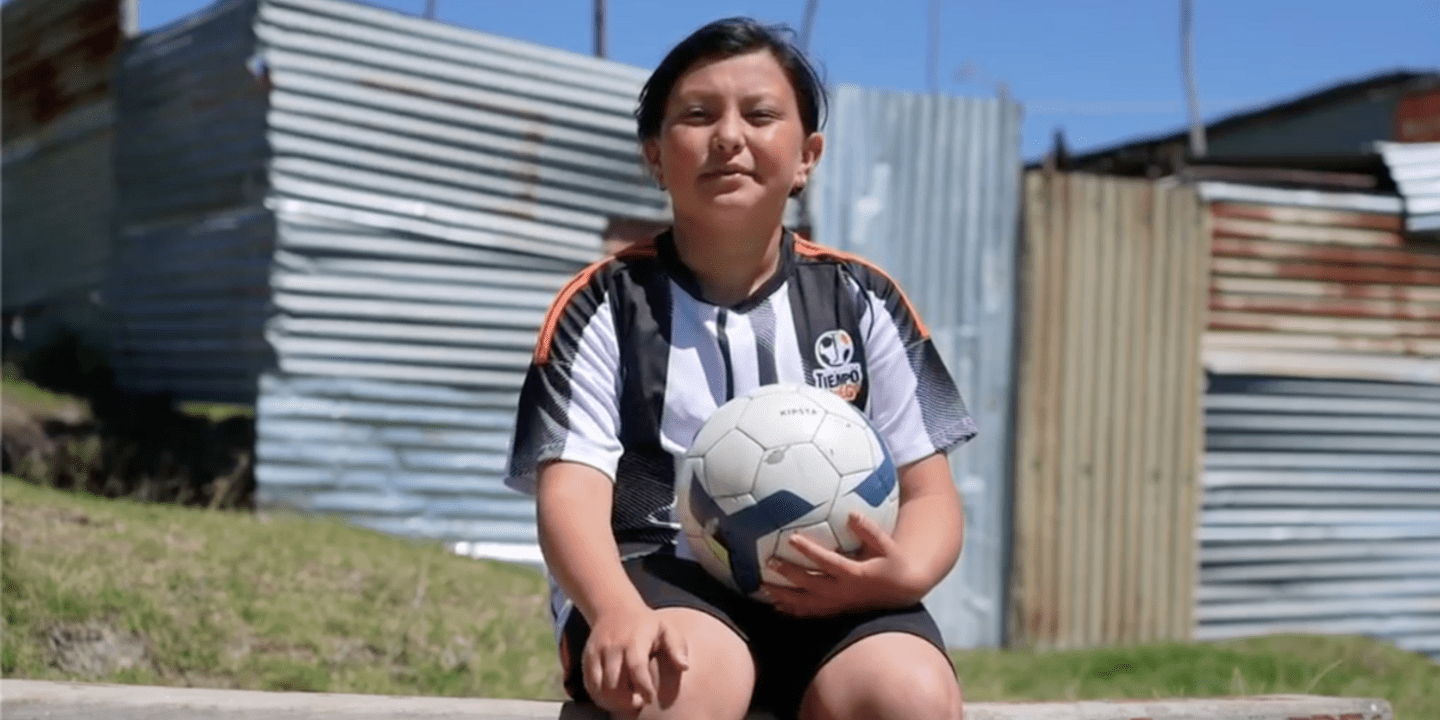
- The 2026 World Cup is on — and skills are the key to winning another equally important match: the Development World Cup. In soccer, skills determine who turns the game around. The same is true for economies.
- The IDB's new Education and Skills Development Thematic Framework 2025-2030 sets out the strategic agenda to strengthen education systems, close skills gaps, and expand the learning opportunities Latin America and the Caribbean needs to thrive.
In soccer, the best teams aren't born on match day. They are built through years of daily work, systematic training, and—above all—the right conditions for talent to thrive. The 2026 World Cup will put that process on display before millions of fans around the world.
Skills development works the same way: behind every person ready to study, work, and innovate lies years of accumulated learning and opportunity. And just as in soccer, results depend on how much is invested—and how wisely—before the game ever begins.
That's why, as the world turns its attention to the World Cup, the Inter-American Development Bank (IDB) is launching its new Education and Skills Development Thematic Framework Document 2025–2030: a strategic blueprint guiding our operations, policy dialogue, and knowledge agenda on skills development across Latin America and the Caribbean. One of the region's most important commitments: turning learning into shared prosperity, and making sure opportunity starts with education.
“Skills are built throughout a lifetime—in the classroom, at work, in the community. The evidence is clear: three additional years of quality learning translate into 15% higher labor income and two additional percentage points of economic growth over four decades.”
— Mercedes Mateo, Chief of the Education Division, Inter-American Development Bank.
Latin America and the Caribbean has made significant gains in access to education over recent decades. But filling classrooms is not enough. The real challenge is converting years of schooling into real, relevant, and useful skills for life and work. This new framework identifies three critical gaps:
1.- Low skills levels among young people. Only 19% of youth complete secondary education with minimum math proficiency. Among young people in the bottom 20% income bracket, that figure drops to 5%. (CIMA, 2022)
2.- Low skills levels among adults. More than 50% of adults in Peru, Ecuador, Chile, and Mexico reach only the minimum literacy proficiency level, meaning they can only read short texts on familiar topics. In OECD countries, that share is below 22%. There are also significant mismatches between education and labor market demands: in Peru, Chile, Ecuador, and Mexico, nearly half of all workers hold jobs unrelated to their field of study. (OECD, 2023; PIAAC)
3.- Skills shortages in the labor market. More than 53% of large firms in the region identify the skills gap as the main barrier to their transformation—ranking it above financial or regulatory constraints. (World Economic Forum, 2025)
The problem isn’t just about resources. The region spends 4.2% of GDP on education, below the OECD’s 5.1%, and per-student spending is just one-third the average of developed countries. But even accounting for income levels, the region gets less learning per dollar invested. The gap is also one of governance, quality, and relevance. (IDB, Thematic Framework 2025–2030). For further insight, view our chart on education expenditure as a percentage of GDP in Latin America and the Caribbean vs OECD. For country level data check the Center for Information on Improving Learning Outcomes, or CIMA in its Spanish acronym.
Closing skills gaps is essential to driving growth and productivity across the region. A boost in cognitive skills equivalent to three additional years of schooling can accelerate economic growth by 2 percentage points of GDP over 40 years and increase labor income by 15%.
Investing in skills is key to both economic growth and social inclusion—and expanding access to secondary and tertiary education was pivotal in reducing labor income inequality in the region in the early 2000s.
At the IDB, we are convinced that now is the time to push for smart spending in education. This isn’t just about numbers—it’s about a commitment to growth and equity. It’s about ensuring that every girl and boy in Latin America and the Caribbean can learn, regardless of where they were born or which school they attend. That is why we will continue to walk alongside the region through this transformation.
In soccer, no team wins on star players alone. It takes structure, organization, and plays that connect. Our new Thematic Framework proposes exactly that: three interdependent pillars that together form an action plan for transforming the region’s skills systems.

Pillar 1. Strengthening Institutional Capacity Across the System
Without strong systems, no intervention can scale. This pillar lays the institutional foundations: equitable and sustainable financing, well-selected and trained teachers, robust performance monitoring systems, and governance structures that separate execution from evaluation and oversight. The starting challenge is significant: the region will need more than 3.2 million additional teachers by 2030 to meet Sustainable Development Goal 4. Education Management Information Systems (EMIS) remain nascent or fragmented in most countries, and quality assurance mechanisms in post-secondary education and technical and vocational training still have significant gaps to close.
Pillar 2. Promoting Continuous Learning Pathways Throughout Life
Learning shouldn’t stop—but in Latin America and the Caribbean, too many people exit the system too early. Only 37% of youth aged 18–24 are enrolled in higher education, compared to 54% in OECD countries. The socioeconomic gap widens at every step: 85% of youth from high-income households complete upper secondary school, versus just 53% from low-income households.
This pillar proposes concrete responses: inclusive and resilient school infrastructure, extended school hours, data-driven early warning systems to identify students at risk of dropping out, targeted financial support, and flexible, modular, and hybrid learning models that allow adults to keep learning without leaving the workforce.
Pillar 3. Increasing the Quality and Relevance of Learning
Access to education does not guarantee the acquisition of useful skills. Some 75% of 15-year-olds in the region score below the minimum proficiency level in math, compared to 31% in OECD countries. Meanwhile, 40% cannot solve basic collaborative problems—a fundamental skill in today’s workplaces.
Addressing this requires evidence-based curricula and structured pedagogy; teachers with sustained, high-quality professional development and in-classroom support; technical and vocational training aligned with labor market needs; and strategic integration of technology—including artificial intelligence—that enhances teaching without replacing the relationship between teacher and student.
The Thematic Framework is more than a diagnosis. It defines lines of action across three priority levels to guide operations, policy dialogue, and the knowledge agenda. Key proposals include:
- Smart spending: needs-based formulas, results-based payment mechanisms, and public-private partnerships for educational infrastructure. The goal: spend more, and spend better.
- Teachers as a strategic asset: merit-based selection, equitable and efficient deployment, sustained professional development, and in-classroom pedagogical support. The evidence is compelling: a great teacher can meaningfully improve student learning in a short time.
- Early warning systems and tutoring: data-driven systems to detect students at risk of dropping out, combined with targeted academic support. In Guatemala, one such system reduced dropout at the primary-to-secondary transition by 9% among participants.
- Technical training aligned with the labor market: employer co-designed curricula, workplace learning, skills certification, and stackable micro-credentials. Only 9% of higher education students in the region are enrolled in technical programs, compared to 30% in North America and East Asia.
- Technology with purpose: technology can be a powerful ally—but only when used well. It’s not about filling classrooms with devices; it’s about putting technology in service of teaching. Learning improves when digital tools and artificial intelligence complement the teacher-student relationship rather than replace it.
Since 2015, the IDB has invested more than $5 billion in skills development through 57 loans and 24 grant operations—reaching nearly 30 million students across the region. More than $2 billion has gone to educational infrastructure. More than 1 million teachers have been reached with training. Over 600,000 students with disabilities and 800,000 Indigenous students have been supported. (IDB, Thematic Framework 2025–2030, Section IV).
The new Thematic Framework incorporates lessons learned from that experience: technology works best when paired with teacher training; results-based financing needs strong institutions to implement it; and no individual program transforms a system without deeper governance reforms.

In soccer, the ball moves between players. Each one receives it, processes it, and passes it on. Nobody wins alone.
What are the skills the region needs to win the Development World Cup?
That is the question we will be exploring throughout the 2026 World Cup. Over the coming weeks, we will share reflections on the skills that can transform Latin America and the Caribbean: which ones are most urgent, what the evidence tells us about how to build them, and what countries can do to close the gap.
Pass it on. Because skills, like soccer, are built together.
____________
The IDB's Education and Skills Development Thematic Framework Document 2025–2030 guides our operational, policy dialogue, and knowledge generation activities across the region.