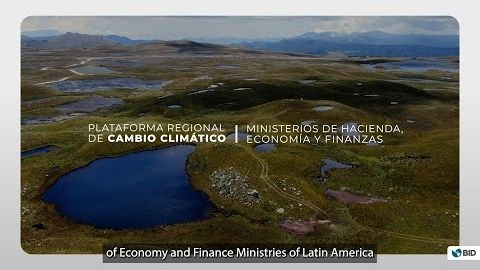
A collaborative network of the Ministries of Economy and Finance of Latin America and the Caribbean, supported by the IDB, aimed at advancing fiscal and economic policies capable of turning climate risks into opportunities for sustainable growth.

Extreme climate events affect not only ecosystems and the livelihoods of millions, but also place significant strain on public finances. Latin America and the Caribbean is among the world’s most vulnerable regions to these impacts.
However, these challenges also represent an opportunity to transform the region’s development model and move toward more resilient, sustainable, and competitive economies. In this process, Ministries of Economy and Finance (MEFs) play a key role in leading a structural shift where environmental and fiscal sustainability go hand in hand.

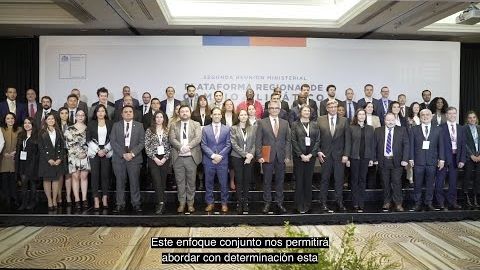
In 2022, in response to this challenge, and upon the request of IDB Governors, the MEF Climate Change Platform was created. The Platform brings together 26 borrowing member countries of the IDB in a collaborative network to discuss regional-specific climate risks and practical fiscal solutions to address them.
Through collective intelligence and specialized knowledge, the Platform is reshaping fiscal policies by mainstreaming climate considerations into their design and implementation, helping the region turn climate risks into development opportunities. The Platform is funded by the International Climate Initiative (IKI) of the German Federal Government.


We promote the integration of climate risks into economic and fiscal planning. This includes accounting for the impact of extreme climate events and transition risks in macroeconomic projections and financial programming tools.

We support MEFs in adopting green public financial management best practices, integrating environmental considerations into public investment management, and promoting sustainable public procurement practices.

We strengthen knowledge and implementation of fiscal and market-based tools, including environmental taxes, carbon markets, and the reform of fiscal incentives for assuring fiscal and environmental sustainability.

We assist in the development of sustainable financing strategies, structuring capital market operations (such as debt-for-nature swaps or sustainable bonds), and strengthening regulatory frameworks to attract private sector investment.

We support the integration of climate risk into the financial systems and promote the development and use of sustainable finance instruments including, green or sustainable taxonomies, green bonds, and ESG guidelines.
We promote the integration of climate risks into economic and fiscal planning. This includes accounting for the impact of extreme climate events and transition risks in macroeconomic projections and financial programming tools.
We support MEFs in adopting green public financial management best practices, integrating environmental considerations into public investment management, and promoting sustainable public procurement practices.
We strengthen knowledge and implementation of fiscal and market-based tools, including environmental taxes, carbon markets, and the reform of fiscal incentives for assuring fiscal and environmental sustainability.
We assist in the development of sustainable financing strategies, structuring capital market operations (such as debt-for-nature swaps or sustainable bonds), and strengthening regulatory frameworks to attract private sector investment.
We support the integration of climate risk into the financial systems and promote the development and use of sustainable finance instruments including, green or sustainable taxonomies, green bonds, and ESG guidelines.
We mainstream biodiversity and climate governance across our priority areas, embedding them in knowledge products and capacity-building efforts.

We integrate biodiversity and natural capital into fiscal policy. This includes understanding how MEFs can influence this agenda based on their roles and mandates, including risks, opportunities, as well as financial instruments.

The Platform supports the strengthening of governance within Ministries of Finance through knowledge exchange on the roles and responsibilities they play in advancing key reforms, that are beneficial for the economy and the environment.
The Platform is organized around three key components: the presidency, the technical secretariat, and the workstreams.

Member countries elect a rotating pro tempore presidency each year. The selected country leads the implementation of the work plan and provides strategic support to member countries. The IDB, as the technical secretariat, offers technical assistance to the presidency in executing and monitoring the work plan. The Platform’s pro tempore presidency is currently held by Peru’s Ministry of Economy and Finance (September 2026–August 2027).

As the Technical Secretariat, the IDB works closely with the pro tempore presidency and MEFs to facilitate collaboration, capacity-building, and experience-sharing. It also coordinates and mobilizes technical support, knowledge dissemination, and funding to help ministries achieve their goals in the priority areas.

To implement the work plan, the Platform structures its activities around thematic areas defined by the interests and priorities of its members and the presidency. Under Brazil’s pro tempore presidency, seven areas are being developed, covering topics such as finance mobilization strategy, sustainable financial instruments, budget tagging and classification systems, sustainable public procurement, among others. The plan also integrates cross-cutting approaches to biodiversity, and governance, with a strong emphasis on policy implementation.

300+
government officials from over 17 member countries have participated in training and capacity-building activities on carbon pricing, taxonomies, and climate public spending.
34+
knowledge products developed –including technical notes, guidelines and strategic studies– in response to country needs.
100+
climate fiscal policies advanced in the region, supported by the Platform’s work.



Discover the topics in which we work to improve lives in Latin America and the Caribbean.
Explore our offices across countries and the work they do to improve lives.