
- Our first two briefs focus on vision loss and hearing loss, two of the most common yet overlooked disabilities affecting school-age children.
- In Latin America and the Caribbean, 1.3 million children experience vision loss, but only 137,000 have been identified. 5.4 million students face hearing difficulties, yet fewer than 3% are recognized.
- The IDB is working hand in hand with ministries of education to screen every child, ensuring that no student goes unnoticed and every learner receives the support they need to thrive.
Right now, across Latin America and the Caribbean, millions of children can't fully see or hear their teachers, and their schools don't know. They are present in attendance records but invisible in disability statistics. They're counted as students but not as students who need support services, such as individualized education plans (IEP). This isn't a hypothetical scenario—it's happening in every country in our region, every day.
To address this issue, we are launching "Hidden in Plain Sight," a new data brief series that reveals the hidden numbers behind educational inclusion. After contrasting education administrative data from ministries of education in 25 countries with estimated prevalence data from the Global Burden of Disease database, we uncovered a troubling reality: millions of students with disabilities are invisible to education systems—sitting in classrooms, struggling to learn, with no one tracking their needs or providing support.
Our first two briefs focus on vision loss and hearing loss, two of the most common yet overlooked disabilities affecting school-age children. The findings are both alarming and actionable.
Vision Loss in Schools: A Common and Easy-to-Fix Yet Impairing Condition
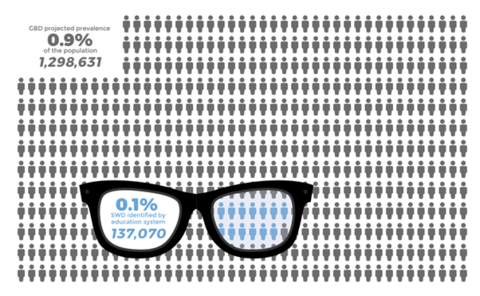
Some 1.3 million school-age children (ages 5-19) in Latin America and the Caribbean have vision loss or blindness. Yet education systems identify only 137,000 students—just 10 percent of those affected.
This means that in Latin America and the Caribbean, over 1.1 million children with visual impairments are invisible to the systems meant to support them.
Severity data indicates that an estimated 89% of children have moderate vision loss (treatable with glasses), 6% have severe vision loss, and 5% have blindness, requiring specialized rehabilitation and assistive technologies.
Students with visual impairment have 1.5 to 2 times higher risk of repeating grades, which means a cost of US$1,500–3,000 per year.
The good news, on the other hand, is that 9 out of 10 vision loss cases are correctable with eyeglasses. And the median cost of comprehensive school vision programs—including screening, refraction, eyeglasses, and follow-up—is just $30-50 per child.
Read the full vision brief to explore country-by-country data, gender disparities, and evidence-based policy recommendations for school-based vision programs.
The hearing loss numbers are even more alarming. Data on prevalence rates estimate that some 5.4 million school-age children in Latin America and the Caribbean have hearing loss or deafness. Yet, administrative data from the ministries of education captures only 3% of these students. That means that over 5.2 million children with hearing impairments remain invisible to education systems.
The region faces a cumulative burden of preventable and acquired hearing loss—including chronic otitis media, post-neonatal meningitis, perinatal infections, noise exposure, and complications of prematurity. These causes, combined with lower coverage of early detection and timely rehabilitation, create a perfect storm of under-identification and under-treatment.
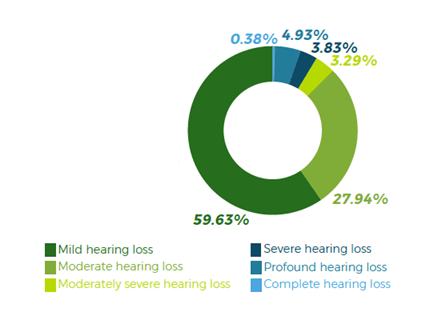
The data indicate that almost 88% of children have mild or moderate hearing loss (treatable with conventional hearing aids), while about 12% present moderately severe to complete hearing loss, often requiring high-cost technologies such as cochlear or bone-conduction implants, along with specialized rehabilitation and support services.
Treating moderate hearing loss cases costs US$1,500 to US$3,000 per child, including screening, diagnosis, professional fitting, bilateral hearing aids for 5 years, and ongoing follow-up adjustments.
Leaving these children without care? It costs $2,500 to $5,000 in additional educational support—not to mention the permanent learning disadvantages that limit their potential throughout life.
Just as with vision, early detection changes everything. Universal hearing screening, timely provision of hearing aids, and teacher training in inclusive practices and sign language can transform outcomes for millions of students.
Read the full hearing brief to explore the regional burden of hearing loss, understand detection gaps by country, and see evidence-based policy recommendations for comprehensive hearing health programs.
We will continue analyzing the data about students with disabilities. Stay tuned to learn more in our next brief!