

The Maturity Model is an interactive tool that assesses the capacity of social protection systems to respond to economic, social, and climate-related shocks. Its objective is to strengthen households’ resilience and adaptive capacity in the face of adverse events.
Developed based on global literature and comparable international tools, the model provides a comprehensive overview of the social protection system in Latin America and the Caribbean, covering contributory and non-contributory programs as well as care services. In addition, it mainstreams the dimension of natural disasters and highlights the role of digital transformation as a key tool for improving the efficiency and flexibility of social protection systems.
The Maturity Model is structured around seven dimensions that are articulated together to form the universe of adaptive social protection from a broad and comprehensive perspective.
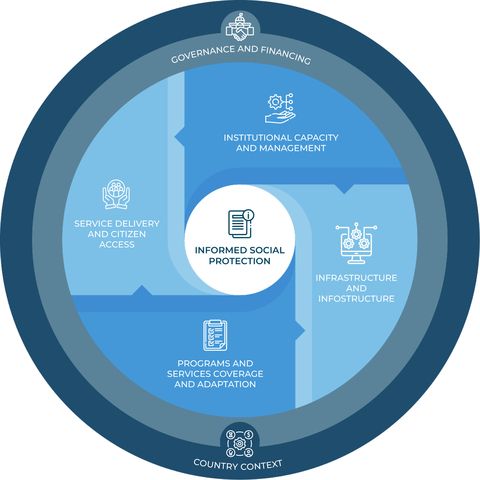
Maturity Model Dimensions
Baseline conditions that shape the scope, risks, and adaptive potential of the social protection system.

Regulatory and institutional framework for social protection and disaster risk management (DRM), including coordination mechanisms, leadership, and contingent financing mechanisms.

The extent to which programs and services reach vulnerable populations and provide adequate support during shocks, including benefit adequacy and scalability across different target populations.
Data systems and interoperability that support identification and targeting through social and beneficiary registries, interoperability across databases and administrative records, and the effective use of data for decision-making. It also assesses the equipment used for the storage and management of the social registry.

Operational capacity to implement adaptive social protection programs, including protocols, intersectoral coordination mechanisms, and the territorial capacity of government entities.
Mechanisms for information collection, payments, communication, complaints, and grievance redress in the interaction between the social protection system and the population and users.
The use of data to inform adaptive social protection actions, including the integration of climate information and early warning systems to strengthen preparedness, response, and resilience.
Towards a more comprehensive, flexible, and sustainable social protection system.
Discover the topics in which we work to improve lives in Latin America and the Caribbean.