
Our region must ensure water for the present and the future with actions to mitigate climate change, a bell that also favors economic and social welfare. This is the theme of the Focus in the Americas sessions during World Water Week.
The consequences of climate change are irreversible as a result of decades of human action on the planet. This dire reality, highlighted in the most recent report by the UN Intergovernmental Panel of Experts on Climate Change, is now felt around the globe with growing concern: intense droughts and unprecedented heat waves in parts of the planet, while floods cause extensive damage in others. Much of the present and future consequences of the climate change we experience now will continue to affect the water and sanitation sector.
"If we unite forces now, we can avoid a climate catastrophe, but there is no time for delays and no place for excuses", said the secretary general of Naciones Unidas, António Guterres, regarding this report. There is no doubt that Latin America and the Caribbean need to move towards resilient and efficient economies. Put simply, we need to advance in the objective of providing universal water and sanitation services, and at the same time, departing from the traditional paradigm to achieve that with a heavy emphasis on gray infrastructure, which is not always friendly with the environment.
It is a task with many challenges. We have advanced in terms of coverage of basic services, but not as fast as we wish. Since the Sustainable Development Goals (SDG) were adopted in 2015, the world has increased the coverage of access to safe managed water by four percentage points, from 70% in 2015 to 74% in 2020. Access to managed sanitation, globally, went from 47% to 54%. However, to achieve universality of both services by 2030, according to the UN Joint Monitoring Program (2020), it is necessary to quadruple the current growth rates of the coverages. In this sense, Latin America and the Caribbean is slightly above the global average in the case of water, this is the second region with lower coverage in the case of sanitation.
Latin America and the Caribbean achieved 75% coverage of access to managed water in a safe way and increased from 28% to 34% in the case of safe sanitation. IDB estimates indicate that at the rate that investments have been made in LAC, SDGs will be achieved by 2075. Universalizing access to water and sanitation in 2030 would require investing around US$27,300 million annually, a five-fold increase in the 2019 investment level. Achieving universal coverage implies giving access to the most vulnerable populations, closing geographic, socioeconomic and ethnic gaps. increase financing in the sector, consolidating governance and planning, and making management in the provision more efficient.
But providing basic services for everyone is only one part of the task. Now more than ever, it is imperative to do so utilizing resilient infrastructure, which not only exploits water resources, but also protects them. Doing this means taking a leap forward across the water and sanitation sector, so we can achieve more with fewer resources. A key move the sector needs is to adopt a culture of innovation at all levels, from policy making, planning with a vision of resilience, novel financing models, investment and management. The sector urgently needs to adopt innovations that have produced important results to improve the quality and balance of water and sanitation services. To achieve these goals we need resources. What should we do to increase the financing of the sector? Why are some places more efficient than others? Perhaps the fundamental question is how to finance climate resilience?
At the IDB this question is central. Climate change resilience is one of the central axles of the 2025 Vision, which guides the work of the IDB in the region. That is why the Focus in the Americas program at World Water Week will focus on how the region is acting to create a sustainable future through a previous climate crisis. In this context, water resources should be at the center of all adaptation and mitigation efforts, which should combine governance, scientific and technological advances and the use of natural-based solutions.
With this vision in mind, the work of assuring significant social and environmentally sustainable impacts must include plans with integral interventions, with solutions not only focused on building infrastructure, but also on achieving the services for our citizens, so we can move forward in overcoming inequality at all levels in the region.
Experience demonstrates that greater effectiveness in the water and sanitation sector is achieved if the planning adopts the watershed approach, which considers bodies of water more than mere reservoirs that supply water but ecosystems in which the complete hydrological cycle occurs, which implies protecting its surroundings in an integral way. This approach also recognizes watersheds as geographic spaces where groups and communities share identities, traditions and culture, and where they socialize and work in function of the availability of renewable and non-renewable resources.
Hence, working with a watershed approach requires establishing the temporal and spatial use of resources in water planning, usually divorced from territorial planning. It is necessary to establish the necessary articulations to achieve the integration of the solutions with the environment. This approach also must be implemented in incremental steps to allow for orderly, flexible and efficient implementation of the plans in order to achieve the expected results and impacts.
This approach is particularly important for our urban centers, where around 80% of our people live. The interventions will have impact and sustainability only if they improve the water and sanitation services that promote better health care services, cultural, sports and leisure facilities, that combine gray and green infrastructure that improves climate resilience.
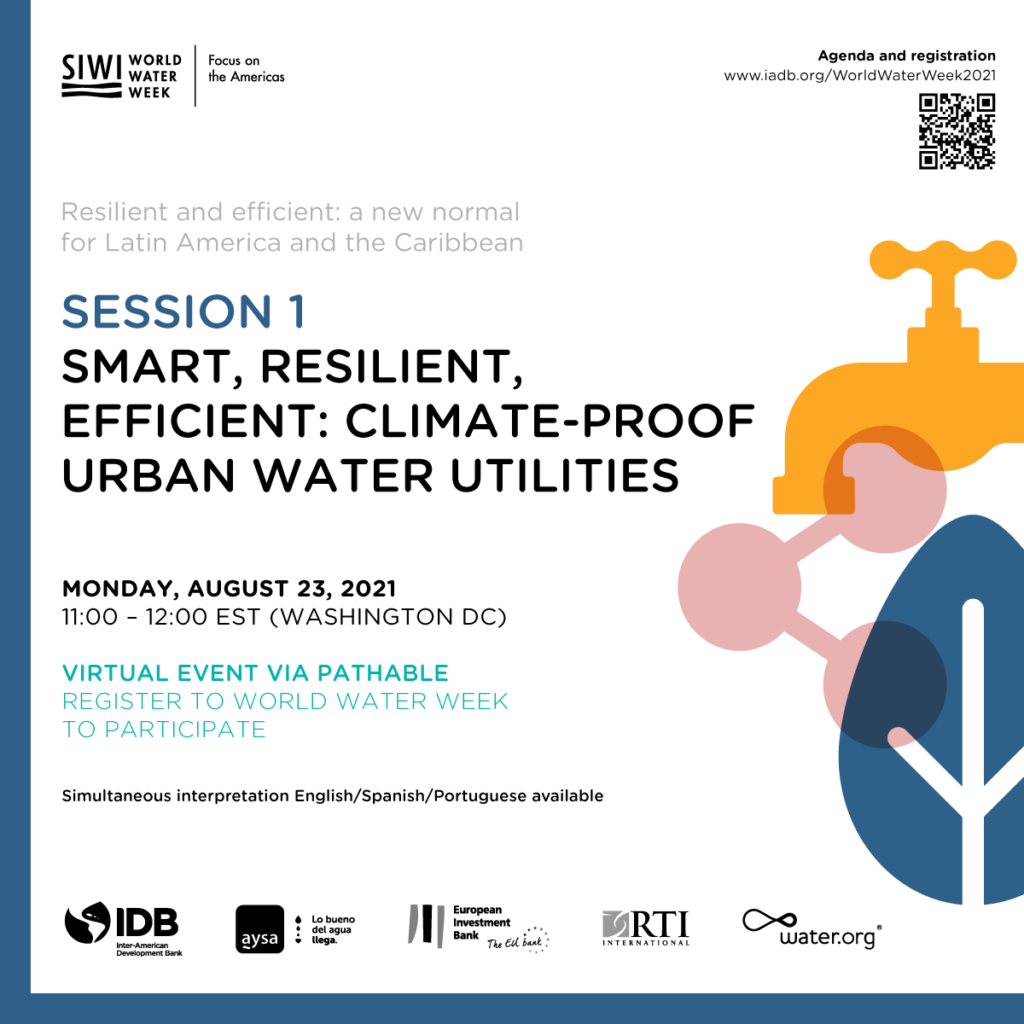
Resilience and efficiency are the central themes of the sessions that we will be coordinating from August 23 during the Focus on the Americas at World Water Week, the most important global event of the year in the water and sanitation sector. I invite you to learn about the agenda and register to participate to this forum that we organize together with our strategic partners.
The moment of post-pandemic recovery places us in a unique position to do Latin America and the Caribbean, without delays and without excuses, a resilient and efficient region.
_______________________________________
If you missed the live sessions of the Focus on the Americas at World Water Week, you can watch them all here:
MONDAY AUGUST 23rd
Session 1: Smart, resilient, efficient: climate-proof urban water utilities
https://youtu.be/PSq5BlXYLm8Seminar 8 (1/3): Climate finance for a green COVID-19 recovery
https://youtu.be/WYDkJKwrDzQSession 2: Digital Water Tech for equity, security and resiliency
https://youtu.be/1LgSYu5JCh4TUESDAY AUGUST 24th
Session 3: Resilient Communities in the Face of Pandemics and Climate Change
https://youtu.be/YpNu-pXfzAwSeminar 8 (2/3): Climate finance for a green COVID-19 recovery
https://youtu.be/OGLnVVXD6FMSession 4: Managing the new normal: water resources and climate crisis
https://youtu.be/OvOOmdw2ge4WEDNESDAY AUGUST 25th
Showcase 1: Stories beyond numbers: tracking systemic and behavioural change
https://youtu.be/GanWWW5QbHQSeminar 8 (3/3): Climate finance for a green COVID-19 recovery
https://youtu.be/4a85gz23RdIShowcase 2: Water savvy communities: best practices from Latin America
https://youtu.be/D4nTmuxD6f4THURSDAY AUGUST 26th
Showcase 3: Mobilizing private sector investments for water security
https://youtu.be/Wpc7bs294KU