
• The Dominican Republic is advancing in the digital transformation of its transport sector with the aim of strengthening road safety, one of the country’s most critical development challenges.
• The use of digital technologies promotes safer mobility, improves institutional management, and optimizes the use of data in the transport sector.
• The IDB’s RutaDigital is helping INTRANT—the public agency responsible for transport in the Dominican Republic—assess its digital maturity and put together a roadmap directed toward more efficient, transparent, and digital processes.
Many parents in the Dominican Republic live with the anxiety that their children have to cross streets under unsafe conditions to get to their schools. This fear is the reality for thousands of families: vehicles traveling at high speeds, limited information, and unpredictable traffic put people’s lives at risk. Road safety is one of the most urgent challenges facing the Dominican Republic, where an average of 2,900 persons lose their lives each year in traffic accidents, placing the country among those with the greatest risk of traffic-related deaths in the region.
In the face of this challenge, the digital transformation of the transport sector, an agenda supported by the Inter-American Development Bank (IDB), can become an important partner to help public institutions strengthen road safety and economic development. According to our recent study, a successful digital transformation of this sector can reduce inequality and generate a net increase in GDP greater than 4 percent.
Technologies such as electronic stability systems have the potential to reduce traffic fatalities by 67 percent, according to the World Bank. The availability and analysis of digital data can also facilitate more accurate interventions. For example, Nairobi used data sources such as social networks and police records to determine that more than half of the accidents there occurred on only 1 percent of the road network. This allowed for focusing infrastructure improvements on 45 kilometers instead of the entire network of 4,500 kilometers.
Aware of the opportunity, the Instituto Nacional de Tránsito y Transporte Terrestre (INTRANT) of the Dominican Republic has taken a significant step forward with the implementation of the INTRANT Digital Initiative. To support the country with this project and its Road Safety Policy Initiative (Política Nacional de Seguridad Vial - PNSV), the IDB’s Transport Division has conducted a technical visit to help the Dominican Republic identify the level of digital maturity of its road agencies through application of the RutaDigital methodology.
Developed by the IDB, RutaDigital measures progress on the digital transformation of road agencies against best practices. This allows for identifying strengths and opportunities for improvement in the use of technology and digitalization of processes that directly impact the public, supporting the design of precise interventions and the establishment of a baseline to assess progress. More specifically, the methodology assesses the level of maturity of the following dimensions:
- Governance and institutions
- Regulatory framework
- Change management and digital talent
- Processes and services
- Sectoral digital technologies and tools
- Crossing-cutting information and infrastructure technologies
- Maturity and capacity relating to data
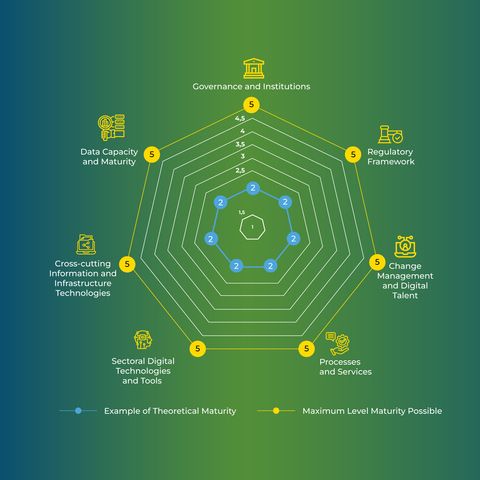
Product of the Transport Division of the IDB
During a mission in August 2025, INTRANT technical teams and IDB specialists analyzed the various components of the model associated with the management of safe mobility, including the dimensions of sectoral technologies, digital talent and change management, and maturity and capacity relating to data.
The application of RutaDigital offered a comprehensive diagnostic of digital maturity, with general and technical recommendations, including rapid improvements that can be structured in projects and other measures that create institutional roadmaps.
For example, the tool allows for identifying opportunities to develop and foster digital talent or to highlight opportunities to improve technological procurement processes. This ensures that digital investments are aligned with institutional priorities and the needs of all who use the roads in the Dominican Republic. The diagnostic provided INTRANT with a more holistic vision of the principal dimensions of its digital transformation process, enabling the institution to be better prepared to address the challenges of this transformation, optimize its activities and processes to promote safer mobility, and boost the INTRANT Digital Initiative.
The digital transformation is not an end in itself, but rather a tool to improve people’s lives by helping to ensure safer roads for their daily travels.
The digitalization of INTRANT will facilitate improving processes to manage and use data on road accidents as the basis for planning, implementation, and monitoring of safe mobility programs. At the same time, it will contribute to more agile and transparent procedures for citizens, opening the door to new forms of participation and the development of improved services. For the IDB, it is important to assist the Dominican Republic in this transformation, both with this initiative as well as others, such as the training of 41 transit agents of the Dirección General de Seguridad de Tránsito y Transporte Terrestre (DIGESETT) who will travel to Spain to attend a Master’s course in Road and Traffic Safety.
For the transport sector, the adoption of advanced technologies means more secure, efficient, and sustainable systems. From traffic monitoring to the management of licenses and permits, the potential of the digital transformation is enormous, and its benefits extend to all of society.