
One of the problems associated with pandemics, like COVID-19, is that as individuals rush to hospitals, the national health care system can get overloaded beyond its capacity to treat people. A potential way to reduce the strain on the system is through telemedicine, the delivery of health care services from one site to another via electronic communications, often through a voice or video call. When the two sides involve two countries, this is referred to as cross-border trade in medical services. While telemedicine cannot replace all in-person care services, the practice is increasingly used in a range of different services from a simple consultation to remote medical procedures. Fostering cross-border trade in medical services is likely to raise quality, increase the variety, and lower prices through an increase in international competition. But it can also be beneficial when the health system in one country is overwhelmed by situations like COVID-19, such as what happened to hospitals in cities like Guayaquil, or by other events like earthquakes or hurricanes that often strike countries in Latin America and the Caribbean. In these instances, some patients may need to rely on the available capacity of the health care system in other countries. Recent events confirm the time has come for Latin America to prepare to trade in telemedicine services. Across the world, telemedicine still represents a small share of health services. It is estimated, for example, that the value of telemedicine in Europe is below 10% of total health care services. Unfortunately, specific data on trade in telemedicine are notoriously lacking. It is widely acknowledged that cross-border trade in medical services is still in its infancy. A 2015 World Health Organization survey conducted in nine Latin American countries found a total of 67 telemedicine practices across different service lines, including dermatology, ophthalmology, and radiology. However, most of these services were national, and only three -in Peru, Argentina and Mexico- had parties located in two different countries. Overall, the evidence indicates that trade of medical services in Latin America and the Caribbean is absent or very narrow in scope. But data on the exports of health-related travel for the European Union, the United States and Costa Rica, one of the leading exporters of these services in Latin America, indicates there is potential demand for trade in medical services (Figure 1). Such willingness suggests a potentially significant demand for trade in telemedicine services as well.
Figure 1: Exports of health-related travel
Millions of US$
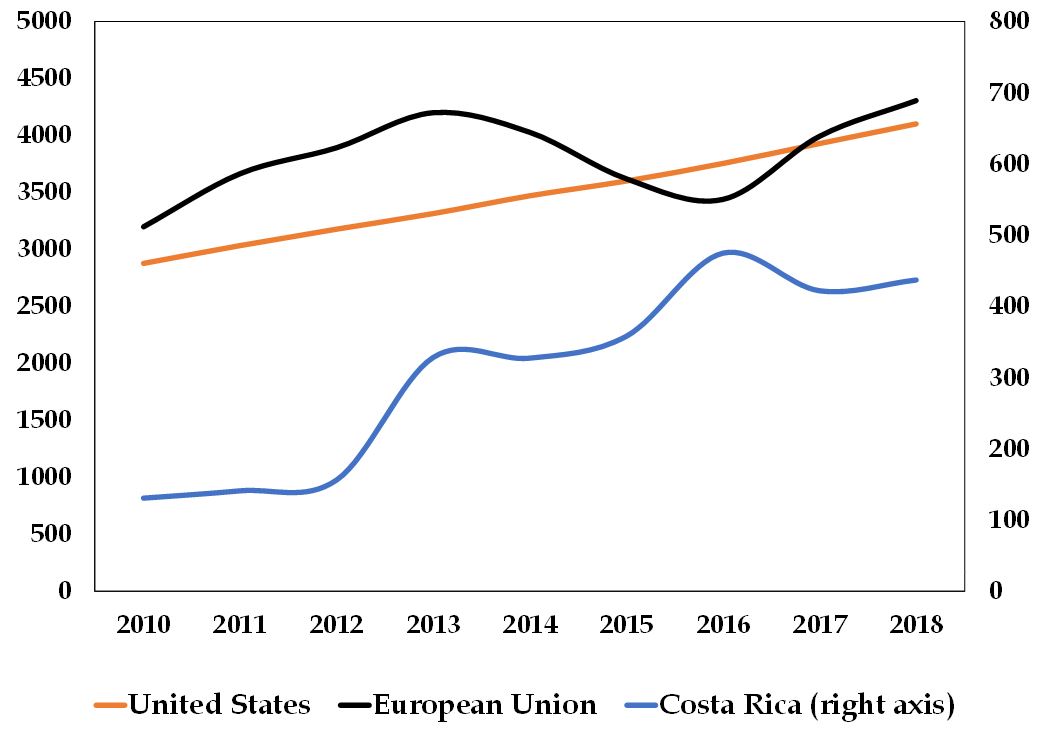
Source: IDB with data from EBOPS 2010
What barriers prevent cross-border trade in medical services?
At the multilateral level, cross-border trade in medical services is governed by the General Agreement on Trade in Services (GATS). In general, the GATS did not exert a large push towards the liberalization of these services. To understand why countries have been hesitant to liberalize their trade in medical services, it is essential to look at the challenges on the ground. These include:- Technological factors. These are related to the potential lack of interoperability frameworks and standards between information technology systems across countries.
- Laws and regulations. Challenges here range from the uncertainty around the liability of health professionals when delivering care across borders, and difficulties in assessing and monitoring the quality of providers in other countries, to concerns in data security and confidentiality of medical records that are transmitted electronically across borders.
- Cultural and language challenges arise when the demand for health services is met by providers from potentially different cultures and backgrounds.