Like millions of mothers around Latin America, Liliana Domador was forced to juggle a job, with the raising of and even teaching of her child as the Covid-19 pandemic closed down schools and afflicted the greatest interruption of in-class education in the region\'s history.
SoDomador, a 34-year-oldPeruvian mother,was delighted when agroupofresearch, development and government institutions came together toimplementa learning platform known asConectaIdeasthat usescomputer-assisted instructionto teachmath skills aligned with the public school curriculum.
Her 11-year-old daughter Alessandra, she recalls, was thrilled to log into her laptop every Thursday to download the platform\'s math-oriented games and exercises. She relished the competition of earning points through the platform and comparing her progress with her friends. That freed up Domador to do more of the other things she needed to do even within the limitations of lockdowns and school closures. "Children like challenges and a bit of competition; they like to win," she said. "As Alejandra began to work really hard and look for solutions through the platform, she became more independent, and that freed me up some."
Extended School Closures
The July 2020 release ofConectaIdeasto 15,000 primary school studentsin 59 of Lima\'s public schools comesas educators become increasinglyattuned to the effectiveness of digital platforms that incorporate gamification, the use of games and competition to stimulate learning.It also arrivesas educators are increasingly concerned about the effects of pandemic-related school closures oneducationand growing inequality between those who have accessto learning materials andeducational supportat homeand those whodon\'t.
Theinitiative is an effort to vaccinate children against learning losses, much like the innovative new vaccines protect people against infection. The danger is thatextendedschool closures—Peru didn\'t have a single day of in-class learning in 2020—could affectstudents\'long-term employmentpossibilities,earning potential, and perception of fairness, as well as productivity on the national level.
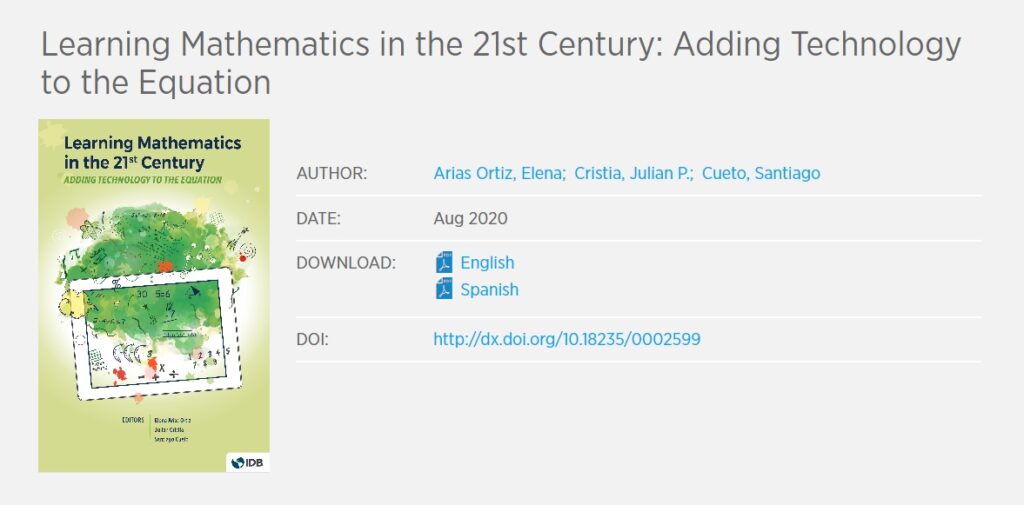
Those collaborating onthe project—a group consisting of the IDB, the University of Chile (which developedConectaIdeas),the private researchcenterGroup of Analysis for Development (GRADE), the International Development Research Center, and the Ministry of Education of Peru—responded by trying to makeremote education during lockdowns more effective. Itfocused on math, because asrevealedin a recentIDB book, that subject readily lends itself todigital instruction, given theimportance of visualization and automatic feedbackto math learning.
Significantly, it used a system that was readily accessible across socioeconomic strata, as it requires only a one-time-per-week connection via cellphone to download the material.
A Heroic Response by Teachers
Teachershave emerged as heroesoftherollout.Despite a historical lack of access to advanced software and training in the use ofcomputer-assisted learning,theyhave invested extra effort to receivetrainingprovided by the group. They have helped children log on to the new system, used the reports on individual students provided by the platform to sharpen their teaching and been eager boosters of it to parents.
Studentsappear torelish entering a newworld beyondtheoften stalememorization and formulasof traditionalclassroom instructionto one whereexercises and games lead them to understand abstract concepts andsharpen their math skills.Theyenjoy learningondigital platforms andput inmore effortthan when theyperform similar tasks in a paper and pencil format.Andthrough the platformthey can track their progress relative to their peers.
Among the fourth and fifth grade primaryschoolinvolved in the study,the percentage of kids using the platform climbed from 1% during the first week of thepilotto 33% four months later, while 90% of students and 95% of teachers said they wanted to use it again in 2021. To date, the accompanying instructional videos have been viewed nearly 800,000 times nationwide.
"My son is enjoying math more than before," said HildaHinojoso, the mother of afifth-gradestudent who went from unconvinced at first to hookedon theplatform. "He has gotten increasingly excited by earning more points, by knowing he can do better. It\'s a game—and a challenge—but he ends up learning."
Sixty-five percent of 15-year-old students from Latin America and the Caribbeanfailed to reach aminimum standardin math on the 2015Progammefor InternationalStudent Assessment (PISA) exam,41 percentage points above the figure for OECD countries.ConectaIdeascan make a difference.In a2017 studyoflow-income primary schools in Santiago, students using the platformimprovedtheir math scores by an average of 50%moreon Chile\'s national standardized exams compared to a control group.
Expanding theFightAgainst Learning Loss
The Peruvian governmentis now askingtheinstitutions leading the initiativeto boostthe 2020 pilot to a national level, covering all public-school students in grades four through six.The use of anintuitive app accessible even from phones without reliable internet will beemphasized, and the government will distribute 300,000 computer tabletswith the app installed. Government TV, radio, and websiteswill be used to promote and complement the project.The platformis especially usefulwhile thepandemic is forcingschoolsto remain closed, butit can alsosupport learning both at school and home after the pandemic is overas students try to make up for lost time and learning opportunities.
Ultimately, given theuniversality of math, the experience can be replicated throughout Latin America and the Caribbean. Perhaps it can even be adopted to other areas of study. "This platformengages students’imagination and their thought processes," saidDomador."I hope it\'sused beyond the pandemic and perhaps even for other subjects, like history."