
It has been atraumaticyear.As theCOVID-19 pandemicspreadaround the world, hundreds of thousands of people inLatin America and the Caribbeandiedandtheeconomyspun into crisis.About 7.4% ofGDPwas lost—the singlelargestrecordedfallin outputin a single year.Lockdowns andrestrictions on human movementled to negative shocks to both supply and demand,and trade and economic activity shrank.Governments provided economic relief, and tax revenues plummeted;fiscal deficitssurged.
Theeconomictoll has been immense.An estimated 10% ofjobs werelost between February and October 2020 (falling to 7% by February 2021), and extremepovertyis projectedto rise from 12% toalmost15%.While the region was already losing ground in terms ofits shareofglobal GDP before the pandemichit,thecrisis hasonlyreinforcedthat trend,threatening to leavecountries poorer, more unequal,and with higher debts.
Governments supported families and firms with transfers to households, lower taxes, and financial programs aimed particularly at supporting small and medium-sized enterprises. The average fiscal packagewas about8.5% of GDP,andthough smaller than the 19% in advanced economies,helped provide a safety net. Overall fiscal deficits rose from 3% of GDP in 2019 to 8.3% of GDP in 2020,as public debt rose from 58% of GDP in 2019 to 72% of GDP in 2020.
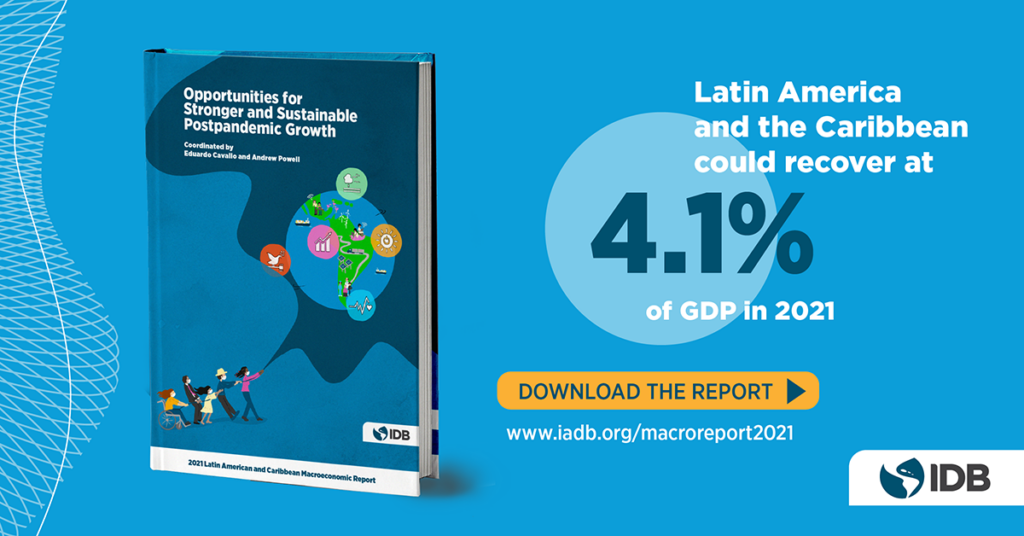
Economic activity has started to bounce back,buthow fast and sustainablethe recoverywill bedependscritically on winning the war against the virus.Current projections put the region on track to grow 4.1% in 2021 with a return to trend growthofabout2.5% per year after that.But as detailed in the2021 Latin American and Caribbean Macroeconomic Report, if vaccine rollouts are delayed or more contagious strains prove to be vaccineresistant, new lockdowns couldresult inpositive growth in 2021that wouldturn negative in 2022,before recovery really tookhold—a double-dip or “W-shaped” recovery.
There are alsoupside risks. China grew in 2020, helping to support commodity prices,and is expected to beat its official target of 6% growth in 2021. Growth projectionshave been boosted in the United States given the additional US$1.9 trillion dollarsin approvedeconomicrelief. Still, longer term interest rates have already risen and if growth prompts the labor market to tighten and push uppriceexpectations,the Federal Reservemaybe forced toalterits patient stance on policy interest rates.Even the hint thatpolicyratesmay starttoclimbcould provoke a financialmarket correction. If that turns out to be mild, simulations suggest growth in Latin America and the Caribbean could be as high as 5.2% in 2021.Butasharpercorrection could wipe out the gainsof a faster global recovery,bringinggrowth ratesfor the regionbacktothe baseline.
Few times in modern Latin American and Caribbean history have beenaschallengingfor policymaking.Governmentsare navigating the narrow path of providing relief to families and firmswhile maintaining fiscal sustainability.Central banks expanded their balance sheetsand will need to pare back their interventions as demand recovers. They will also have tomanage roll-overs of short-term liabilities. Bank balance sheets may be hiding substantial risks as deferred loans continue to mature.Public guarantee programs may createadditional fiscal burdens. Argentina, Barbados and Ecuador have already restructured debts. Other countries may face tough decisions in the months ahead.
Finding the right fiscal strategy will be key.Each country will have its own recipe. Ingeneral,inSouth America, there is alargetax take and spending levels are high.Soseeking greater efficiencytherecould bring very significant rewards. In Central America, countries with low takes have ample room to increasetaxes. Assuming a high level of efficiency,they could alsoboostwell-targeted spending.
Just increasing efficiency could yield up to 4.4% of GDP per year on average, and more in some cases.Enhancing the tax base and reducing informality, avoidance,and evasion could bring additionalsubstantialrewards, and allow for lower tax rates orhigherbeneficial spendingon education or on health.
The timing of fiscal consolidation after the crisis will have to be managedverycarefully. If it is too fast,recovery maystall.If it is too slow,debt sustainability may beput at risk. Improvingfiscal institutionswould provide immediate benefits.Greater credibility wouldallowfor a more gradual adjustment with lower interest ratesthat wouldreducethe potential risks of consolidation.
Withcrisesalso come opportunities.Multinational companies have been rethinking their supply chains. The United States switched over US$50billionof imports to new suppliers. This represents a huge opportunity as the region only exports aboutUS$26billiontoits northern neighbor.Still, many firms find itdifficult to participateona consistent basis in global value chains. Improvingthe work of export agencies,as well aslogistics,tradeinfrastructureand trade finance,couldallhelp.
Boosting regional value chains could allow firms in the region tobecome more competitiveinternationally. But the spaghetti-bowl of regional trade agreements hasmany inconsistencies that prevent regional supply chains from developing. A bottom-up approach to ensure consistency could lead to increases in regional trade andto more globally competitive firms.
The crisis particularly hurt labor-intensive sectors where social distancing washard.Evidence from previous crises showsthat these sectors are likely to bounce back asthe health crisis fades.These sectors, however,have the lowestlevels ofproductivity.Sothe crisis provides an opportunitytorebuild them into more productive versions of themselves. With the right policies to promote formality andallow successful firms to grow, these sectorscould be transformedto boost productivity in general.
There is also an urgent need to boost infrastructure investment. This could befinancedeitherthrough the public sector,bytaking advantage of fiscal savings, orthroughfinancingfromprivate sources. Well-chosen projects benefit low-income families,promotinginclusive growth.Infrastructurealsohas spillovers to other sectors.And the right projects can boost productivity in sectors as they recover.
Each peso of investment in infrastructure adds abouttwopesos to GDP. Butefficiency ininfrastructure investment leaves a lot to be desired. If thiscould be improved, multipliers could be even higher.
Finally,the region is still facinganotherchallengethat has not disappeared—namely theclimate crisis.Here there issomegood news. Technology has advanced to the extent that there is now norealtrade-off between climategoalsand growth objectives.Adopting ambitious climate goals can be growth-enhancing.By expanding renewable electricity capacity and electricity grids,increasingelectricalmobility, boosting mass transit, and improving energy efficiency in the residential,commercial,and industrial sectors, countries of the region can create millions of jobs and add about 1.3 percentage points of incremental growth per year.
Our reportprovidesfurtherdetailsaboutthe risks andrecommendationson howtheregioncanmovepasttheupheavals of the pandemic.It suggestspolicies toreduce vulnerabilitiesandtobuild afoundation forhigher growth, withmore inclusive and sustainable economies. There is no time like a crisisto shakeup old ways and start anew on a more promising path—and that time is now.