
6 min. read.
When it comes to creativity and innovation, divergent thinking is a great way to tap into the recesses of your brain and bring forth new and novel ideas. It can be especially useful in helping you get “un-stuck” when you are trying to think about a problem differently or come up with a new approach. This process, however, doesn’t always happen spontaneously, and simple structured methodologies can be employed to access this important resource.This article will teach you a simple method/technique to engage a group in a divergent thinking process, and get your team unstuck.
Originally, we designed this methodology in order to help a team come up with an idea for the title of a publication, which resulted in Know How Now. Since then, it has been used on numerous occasions to help teams come up with new ideas for projects, names for events, and more.
This is an open collaboration methodology in its rawest form, designed to happen quickly, and a little uncomfortably, to get people to participate in unexpected ways. This methodology was designed to take place in-person, with a random mix of participants, in 15 minutes or less, and it could easily take place in a virtual setting with the help of online collaboration spaces like Miro or Mural.
Preparing for the ideation session
1. To prepare, it is important to create a short context description, which provides enough information to spark ideas but not so much as to bias the participants. This description should take no longer than 15 – 20 seconds to read and is what will kick off the session.
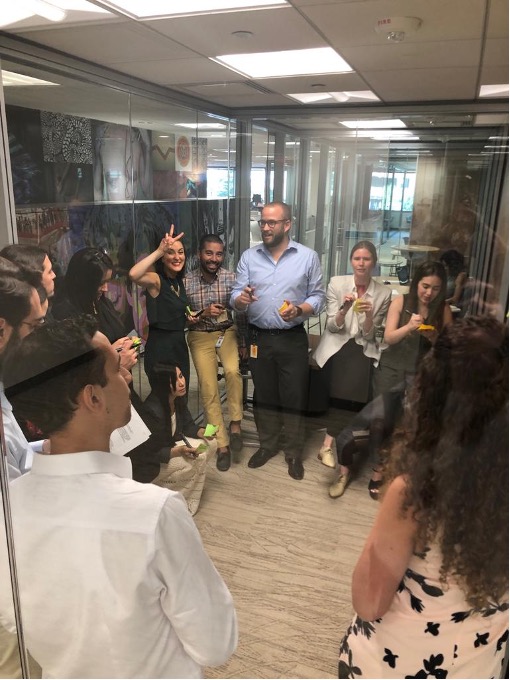
Explaining the rules of engagement
Source: Inter-American Development Bank (IDB)
2. Convene a list of participants, trying to include as many different perspectives and experiences as possible in order to enrich the quality and range of ideas. Here is an example message for convening the group:
Subject: Help! We’re stuck in a box!
Body: We are trying to name an upcoming publication, and we need your help to give us a fresh perspective! Come to room 211 (which is the size of a box!) for a 15-minute creative blast to generate as many idea names as possible! The less you know about the publication, the better! It’s totally optional, and only come if you want to have fun. This is an open canvas that needs your artistry!
3. Since this dynamic takes place with people standing as much as possible, try to find a small room, without chairs or tables. The only materials required are sticky notes (or a whiteboard could work in a pinch), writing implements for each person, a timer, and a blank wall for sticking the ideas.
During the ideation session
To help manage the process, here are the rules of engagement:
- One idea per sticky note.
Remind participants to limit each note to a single idea. They should read the post-it out loud to the group, stick it on the wall, and start writing another one. Repeat this process for as many ideas as possible during the 15-minute session.
- No Discussion.
It can be tempting to respond to others’ ideas verbally, especially when they spark new ideas in your head. If you feel the urge to discuss an idea that someone has just read out loud, respond instead by writing down your idea on a sticky note. You’re highly encouraged to riff, spin, or play off others’ ideas. That’s part of the open collaboration magic!
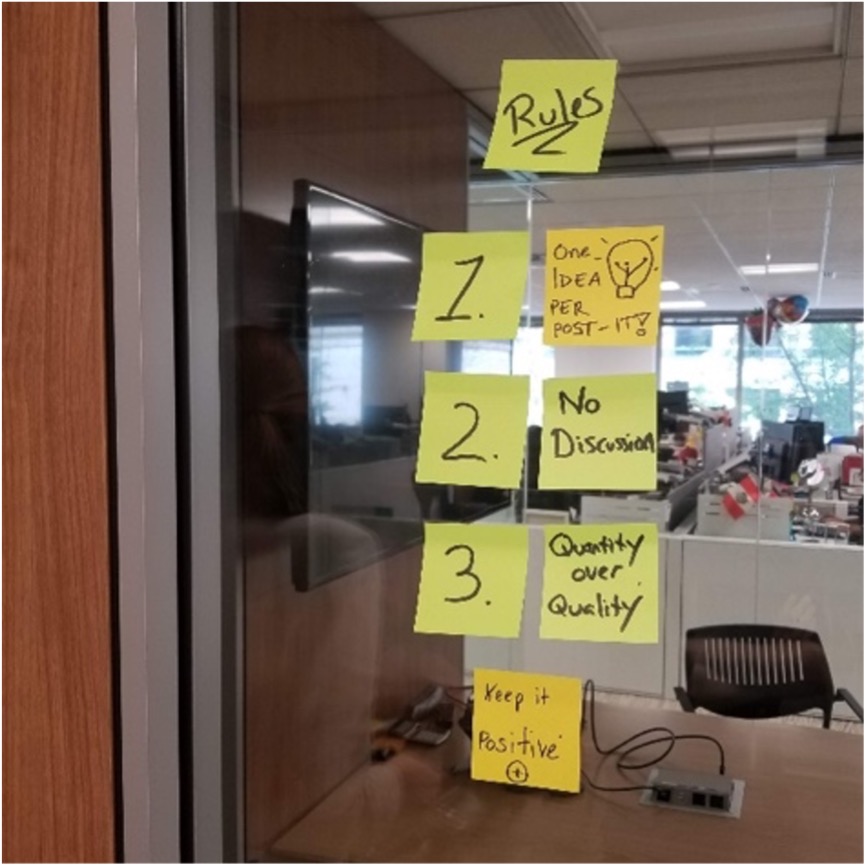
The Rules of Engagement on display for participants
Source: Inter-American Development Bank (IDB)
- Quantity over quality.
The more ideas the better, so don’t over think it. Remember that this is a divergent thinking process, and it works best when all ideas are committed to paper because each idea shared will spark more ideas, which is the whole point.
- Keep it Positive!
Make sure that this is a supportive space, where ideas are encouraged. Remind participants that here is no such thing as a bad idea here! All ideas are welcome no matter how incremental, big, or out there.
The Rules of Engagement on display for participants.
The session should quickly run as follows:
- Thank participants and remind them that this is a quick dynamic that should take no more than 15 minutes.
- Hand out sticky notes and pens.
- Briefly explain the rules of engagement to the group:
- Read the context description.
- Set a timer for a maximum of 15 minutes and begin!
When the timer goes off, thank everyone for their participation and end the session.High-fives are always encouraged.Now you have a wall full of fresh ideas to ponder. Wonderful!
The output: A wonderful wall of new ideas!
The output: A wonderful wall of new ideas!
Source: Inter-American Development Bank (IDB)
After the ideation session
Now that so many new ideas have been generated, it’s time to analyze them. During another 15 minutes, the facilitator and challenge owner should review all of the sticky notes and group related ideas on the wall. While doing so, discuss any concepts or ideas that resonate with the challenge at hand.
From here, two paths emerge:
- If reflecting on the ideas has inspired you and given you the response you were looking for, you’re done!
- If not, consolidate any groups of related ideas in a single new note as needed, or select 3 to 5 ideas that responded best to your challenge. Then bring this to a vote with the challenge owner and any other core stakeholders to choose a response. Tip: When voting, it can be very useful to use the ”dotmocracy” method.
Congratulations!
Congratulations, now you are out of the box! It only took a little bit of preparation, a 15-minute dynamic, a dash of analysis, and the help of a few willing colleagues.
How will you use this methodology to unstick your project? Tell us about you experience in the comments section below.
By Kyle Strand, Senior Knowledge Management Specialist in the Knowledge and Learning Department of the Inter-American Development Bank.