
Suriname isundoubtedlyonefascinatingcountry as it is multicultural, multi-lingual,andevenmulti-gastronomic–which presents someexciting decision-making when it comes to food.Butdespitethese assets, the country is also highly vulnerable, especiallyto the impacts of climate changeand natural disasters.
In the country, sea-level riseparticularly exacerbatesthis vulnerabilitysince most of the population, economic activity,critical infrastructureand fertile land are located within thecoastal zone,including the capital city ofParamaribo.
Estimates suggest thata 1-meter riseof the seawould impact over 6.4% GDP, 7% of the population, and 5.6% agricultural land. Whilesea-level risemayamajor risk factorwithin coastal areas, it is expected that climate changeimpacts willalsobe significant risk factorsto other parts of the country.
Fortunately, Suriname has been proactive and has embarked on a mission tobetterunderstandfutureclimatechangeanditspotential effects of sea-level rise, drought, and floods on its population and economy. This way, decision-makers in the country can determine the adequate measures to address these risks that could threaten thecountry's sustainable development.
The IDB is supporting Suriname in mainstreaming climate change intopolicymaking.
The IDB has become a key partner to the Government of Suriname in this critical mission. Through technical cooperation support, the Bank supportsthe governmentin mainstreaming climate change into policy decision-making. One of the key outputs of this initiative is the State of the Environment Report (SoE).
TheSoEanalyses Suriname's historicaland future climatescenarios by looking at climate variables such asrainfall, temperature, wind, humidity,and sea-level rise.By establishingdifferent time horizons, the report shows thechangesin these variables in time and lists potential impacts and risks to agriculture, infrastructure, energy, water, and forestry.
The process of elaborating theSoEhas been a comprehensive effort from the IDB and the Government of Suriname to gather and analyze the most up-to-date and reliable climate data to ensure theassessmenthas scientific rigor. There has also been an important dialogue with sectorial experts and stakeholders to validate the results. As a result, theSoEis a reliable tool for policy-planners and decision-makers in Suriname.
What are the prospects of a changing climate in Suriname?
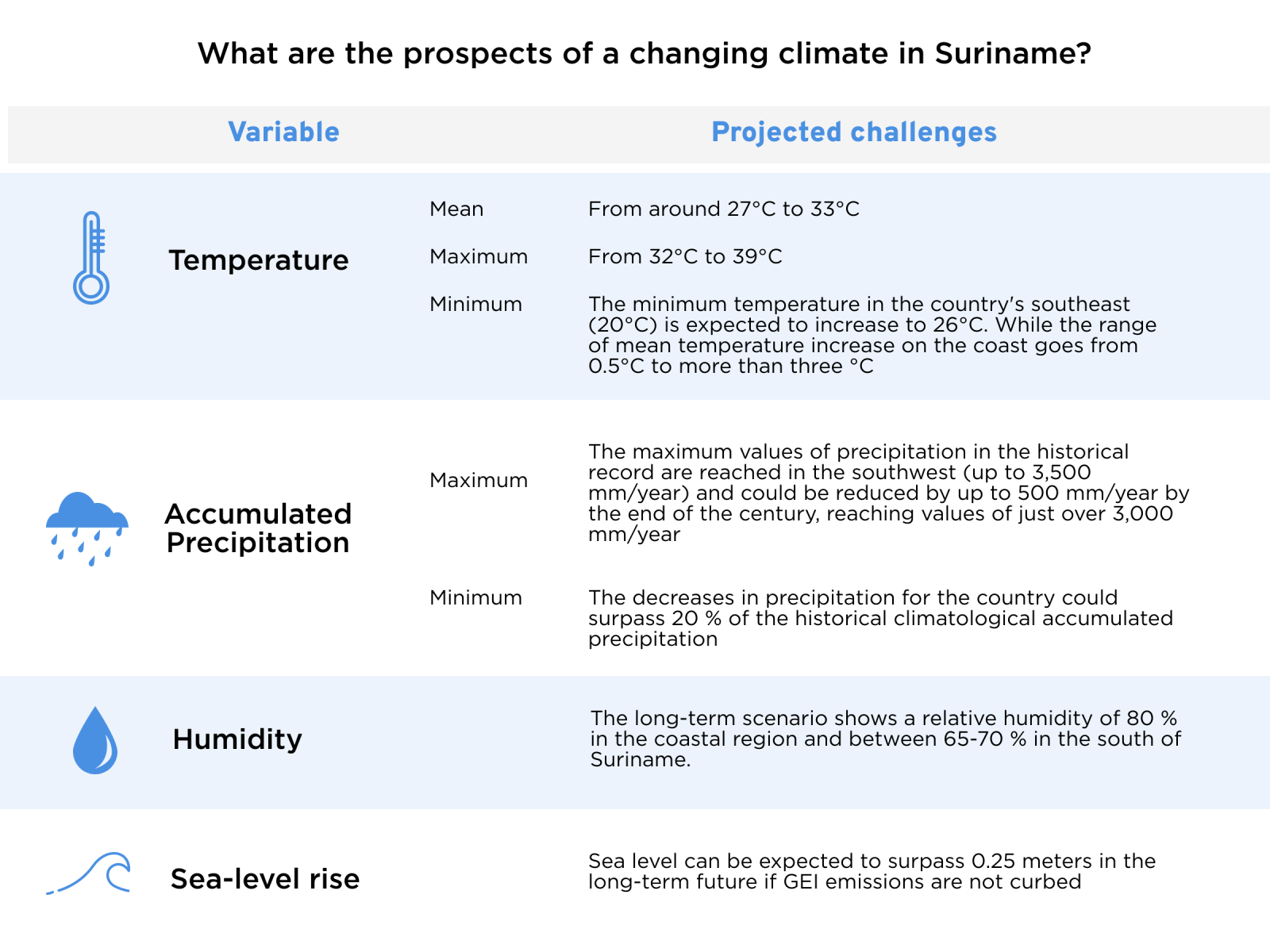
TheSoEshows results that foresee Suriname's challenging climate scenarios, especially in increased temperatures (mean and maximum) and accumulated precipitation(See infographic).
In general terms, an increase of between 5°Cand 6°Cinthetemperatureisexpected at the end of the 21st century.Also, adecrease inthe accumulatedprecipitationof20%compared tohistoricalrecords is expected.Regarding sea-levelrise,itcan be expected to surpass 0.25 meters in the long-term future ifgreenhouse gasemissions are not curbed.It isundoubtedly a challenging future scenario for decision-makers and the population in Suriname.
These scenarios could translate into a severe impact on water availability/quality and loss of productive and residential land. Also,more extreme climate conditions could impact assets and services from the energy and infrastructure sectors.It is also estimated that a 20% increase in climate-change-related hazardscould occur, especially in Paramaribo.If no mitigation or adaptation measures are put in place, the country's public health, food security, and power independence could be seriously threatened, and the prospects of sustainability and competitiveness diminished. In general, the vulnerability of society and the economy to climate change phenomena will increase, demanding concrete solutions to thesechallenging prospects.
Projected climate challenges in Suriname.
Source: State of the Environment Report(2021).
Where does Suriname go from here?
It is expected that the findings from theSoEwill be widely consulted by government officials and the international cooperation community to come up with concrete measures for society and the economy to better mitigate and adapt to any potential climate-change-related risk.
In that sense, to define the next steps to leverage from the inputs ofSoEin the decision-making process,technical validation and awareness-raising workshops were organizedin March of this year. The virtual event gathered the most important representatives from the governmentand the international cooperation of Suriname. During the two-day event, a fruitful discussion took place,and thefindings of theSoEwere validated.
Stakeholdershighlighted that it is essentialforSurinametohaveupdatedclimatechange policies and targets in place, as well as robust institutional arrangementstoensure their implementation.These policies should be sector-bindingto enablean adequatemainstreaming of climate change adaptation and resilience enhancementinto day-to-day operations.It was highlighted that climate change shouldbecome a national agenda instead of solely a concern of the environment, authorities.
Also, local capacities should bestrengthenedto addressthe mosturgentchallenges established by theSoE.This processshouldcomplementthe introduction ofstate-of-the-arttechnologytoolsto support thework ofrelevant institutions such as theMeteorologicalDepartment Suriname and theNational Institute for Environment & Development (NIMOS).
Among the mostnotablefollow-upmeasuresdiscussedduring the workshopsiscreatinga climate change knowledge database. This database will bethe main reservoir of data and information from all relevant sectors and improve decision-makingby providing updated and reliable inputs to stakeholders.
TheSoEisan excellent resource to complement other effortssuch asSuriname'sNationally Determined Contribution (NDC)of the Paris Agreement on climate changeand the National Communications to the United Nations Framework Convention on Climate Change (UNFCCC), whichcountries are committed to do. By providing science-based evidence, theSoEshould serve as a resource for prioritization amongst policy planners.
Suriname continues to step in the right direction in addressing climate change.Science-based decision-making is key to face the challenges Suriname faces. The recent pandemic is evidence of that.TheSoEwill surely help thecountryplan and pursueaclimate-resilientfutureand ensure thewellbeing ofits citizens.
Further reading:
Suriname's updated national climate plan can help drive a sustainable recovery
NDC Invest and climate ambition: How Suriname enhanced its NDC on the way to COP25
Síguenosen Twitter: @BIDCambioClima