- In Haiti, where poverty and instability limit opportunities, cash for work provides young people with temporary employment and income.
- Participants gain technical and workplace skills that can lead to new job opportunities.
- Their work improves community infrastructure and strengthens household and community resilience.
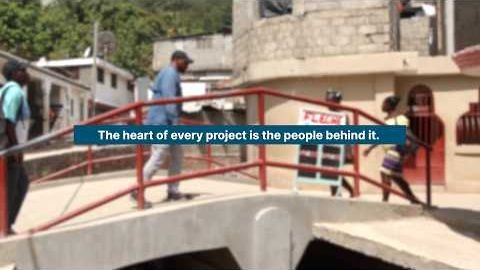
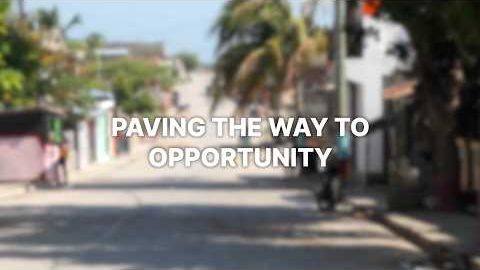
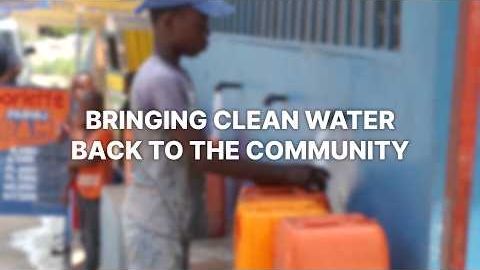
A bridge reconnecting a community after being destroyed by a natural disaster. A sports court restored after a hurricane. A road that no longer turns to mud every time it rains. A water kiosk providing year-round access to water without requiring people to walk for hours. At first glance, these may seem like small infrastructure projects. But behind each one are young people who helped build them and communities whose lives have improved as a result.
In Haiti, where poverty, instability, and extreme natural events limit development opportunities for thousands of young people, cash for work projects (HA-L1137 and HA-J0011) seek to address two challenges at once: generating temporary employment for people in vulnerable situations and implementing interventions that improve people’s quality of life.
With support from the Inter-American Development Bank (IDB), the Economic and Social Assistance Fund (FAES) implements these interventions in collaboration with nongovernmental organizations working in the country: the Center for International Studies and Cooperation (CECI), VivaRio, CARE, PADF, and AVSI. More than 100,000 people have already participated directly in Cash for Work projects, and an estimated 85,000 more are expected to participate by 2028.
Cash-for-work projects provide a temporary source of income to people and communities in need while helping rehabilitate or build infrastructure and other community assets.
For several months, participants receive compensation for working on community projects and gain experience in activities such as construction, painting, welding, and maintenance. In addition to technical expertise, they develop skills that are highly valued in any workplace, including teamwork, responsibility, and punctuality.
As part of the completion of projects under operation HA-L1137, focus groups were conducted with beneficiaries to learn firsthand how the program had influenced their employment trajectories and daily lives. Their stories show that some participants found new jobs, partly because of the skills and visibility they gained while working on the projects.
One of the young people who helped rehabilitate a sports court destroyed by the hurricane reflected: “We live in a country where young people are not always valued as much as we should be. But many of us have skills and knowledge, and we are ready to put them into practice.”
In a context where more than half of the population faces severe food insecurity, a temporary income can help people pursue personal goals and meet immediate needs.
Participants used the money in different ways, from purchasing food for their households to continuing their education, paying their children’s school expenses, or financially supporting their parents and other relatives. The focus groups also indicate that, in some cases, participants were able to save money or take the first steps toward starting a small business.
One young participant told us: “The money I received allowed me to continue my university studies.” Another said: “The money I earned helped me pay my rent, send my children to school, and support my mother, father, and other relatives. It improved my life because I was able to do things I had not been able to do before.”
On International Youth Day, these stories remind us that opportunities can take many forms and that temporary employment, training, or the chance to contribute to the recovery of one’s own community can change a person’s life forever.
Through initiatives such as cash for work, the IDB works alongside its partners to strengthen young people’s employment prospects and build greater resilience to the challenges facing Haiti.
Learn more about their experiences in these videos: