
“Can you imagine your home without internet, a fan, or a refrigerator?” asks Pedro Torres, a power utility worker in Rio de Janeiro, Brazil, in a televised message. “I have a seven-and-a-half-month pregnant wife. If you can, please stay home,” he adds before going down a manhole to check electrical equipment.
Torres is an essential worker who continues to work during the COVID-19 quarantine; jobs like his prevent the lights from going out. The pandemic has disrupted every facet of life here. We now communicate with our loved ones mainly through digital means, and remote work has become the new normal for many.
As the number of infections in the region rises, access to basic services is crucial to saving lives. Blackouts at hospitals or water plants are not an option.
“The most important challenge for electricity companies in the region has been to ensure the continuity of services despite the effects of the pandemic. This isn’t an industry in which people can work from home; you have to operate 24/7 to ensure electricity reaches homes reliably,” says Ariel Yépez, chief of the Energy Division at the Inter-American Development Bank (IDB).
Providing affordable and dependable electrical service to 600 million Latin Americans is a major challenge even in normal times. The region’s response since the first cases of COVID-19 were detected last March has reflected a sense of urgency.
“The first objective for governments was to ensure no home was left without electricity. In nearly every country of the region, a decision was made not to disconnect any residential users, even those who could not pay their bills,” says Yépez.
“Other measures taken were the deferral of payments, for up to three months. Costa Rica and Panama were the first to announce it. Some countries even reduced their rates," adds Yépez.
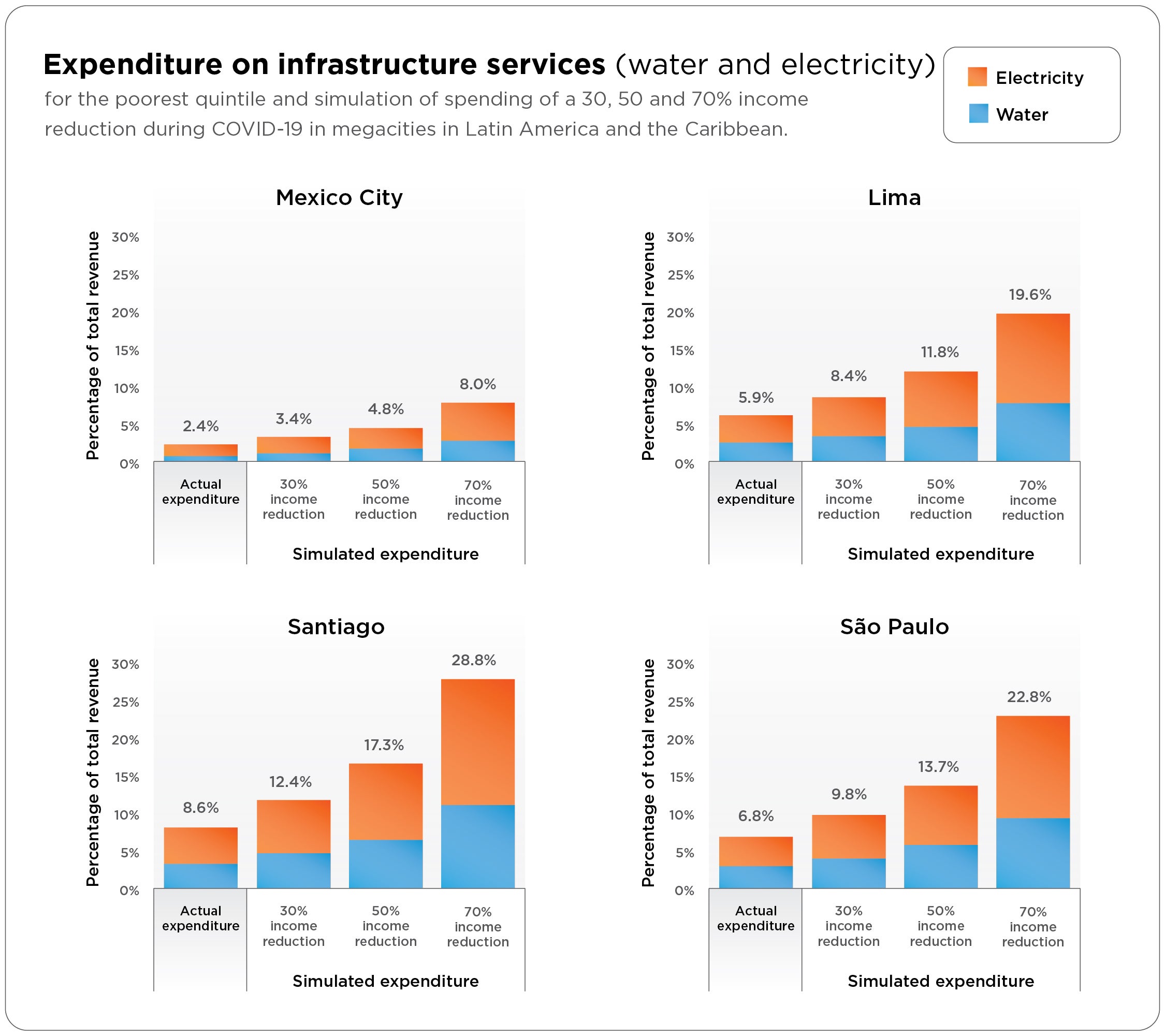
Source: Based on Household Expenditure Surveys: 2017 for Mexico City, 2018 for Lima and Santiago, and 2019 for São Paulo (Cavallo, Powell and Serebrisky, 2020)
To ensure the safety of employees like Torres, electricity companies have provided them with personal protective equipment, especially masks and gloves. Additionally, management strategies were implemented to avoid contact with customers and other persons. Among these measures are the division of their teams into smaller groups, the establishment of more work shifts, and isolation from the rest of the population.
"You cannot send out workers without protection, because if they get sick, you will be in the worst-case scenario: you will no longer be able to guarantee the supply of the service," says Yépez.
"Almost all countries have decreed water and solid waste management services as essential and exempt from quarantine," says Sergio Campos, head of the IDB's Water and Sanitation Division, who outlines measures similar to those taken in the electricity sector.
"They range from El Salvador, where payment was suspended, to Bolivia, where subsidies were implemented, to Colombia, where outstanding debts can be paid over the next three years," he says.
In a symposium organized by the IDB for water and sanitation service providers, Cristina Arango, manager of the Bogotá Aqueduct and Sewer Company, detailed the measures taken to face the challenge.
“We have 1,570 people working in field operations needed for water to reach our clients. This required implementing a new manual for cleaning and disinfection, as well as more than 12,000 training sessions to reach the highest levels of protection. Constant disinfection of vehicles and coveralls, and the delivery of all the protection elements have been carried out. We monitor our workers’ health daily and have implemented quarantines.”
All these efforts are taking place in a context already rife with gaps in access. The pandemic has made them even more urgent.
Even before the economic and social impact of COVID-19, nearly 18 million people in Latin America and the Caribbean lived in energy poverty: households without electricity, or the means to afford it.
Ready access to drinking water remains a challenge in the region, where 30% still lack constant access to this basic service. Vulnerable populations are doubly impacted: they incur greater physical and financial expenses to obtain water from alternative sources such as wells, tank trucks, or bottled water.
“About a third of the population in Latin America receives intermittent service. That’s more than 200 million people," Campos explains. “Those who are most affected by this crisis are the most vulnerable. Of the first two quintiles of the income distribution, the poorest and most vulnerable, 70% do not have access to drinking water, and 85% do not have access to sanitation. For them, hand washing is not a given."
Faced with historical challenges now exacerbated by a crisis whose ramifications could be felt for years, the answers lie not only in the present but in planning for a different future.
For Yépez, this requires starting to plan for recovery after the pandemic. It involves not only supporting power companies but also investing in renewable energy generation and universal access to electricity.
“With COVID-19, what we see is an opportunity to help countries promote the development goals of providing access for all. When the economic reactivation begins, the goal of giving universal access to electricity can be a source of jobs, and new sources of income will be created,” he says.
For the water and sanitation sector, the priority in the region has been to ensure that water reaches those who do not have it, expanding coverage to respond to the crisis. In Peru, the Lima Drinking Water and Sewerage Service (SEDAPAL) has distributed water daily for free to 700,000 people.
“In agreement with the government, we assumed the commitment to deliver water to all unmanaged areas, and more than 300 tankers were hired to supply them,” says Jorge Rucoba Tello, SEDAPAL’s development and research manager, during the colloquium organized by the IDB.
This type of measure is part of a three-pronged strategy that must cover both the present and the future of the sector, says Campos.
“The first is to ensure financial flows for the proper operation and maintenance of infrastructure: that companies have the means to pay their staff and carry out routine maintenance. Without resources, they will not provide water and sanitation, and other diseases such as diarrhea, dengue, or zika will arise, putting much more stress on the health system,” he says. “The second is that if the most vulnerable populations are not provided with access to water and sanitation, the pandemic will not go away. The third line of work is emergency plans: many companies are going to have to hire more work shifts, finance overtime, emergency repairs, and the purchase of additional equipment.”
These efforts can underpin the kind of improvements required to accelerate connectivity for vulnerable populations, reduce coverage gaps, improve system management, and prevent the loss of half of all liquid in the pipes before it reaches consumers.
From inspecting public lighting to ensuring water flows from the tap, our daily lives are possible thanks to the work of countless people who guarantee the continuity of services. Those jobs have been, are, and will continue to be essential, before, during, and after the pandemic.
To learn more about essential services, download our latest publications on the subject:
· Response plan for drinking water systems: Focus on the COVID-19 pandemic (in Spanish)
· COVID-19 and the electricity sector in Latin America and the Caribbean: How to help vulnerable groups during the pandemic? (In Spanish)