
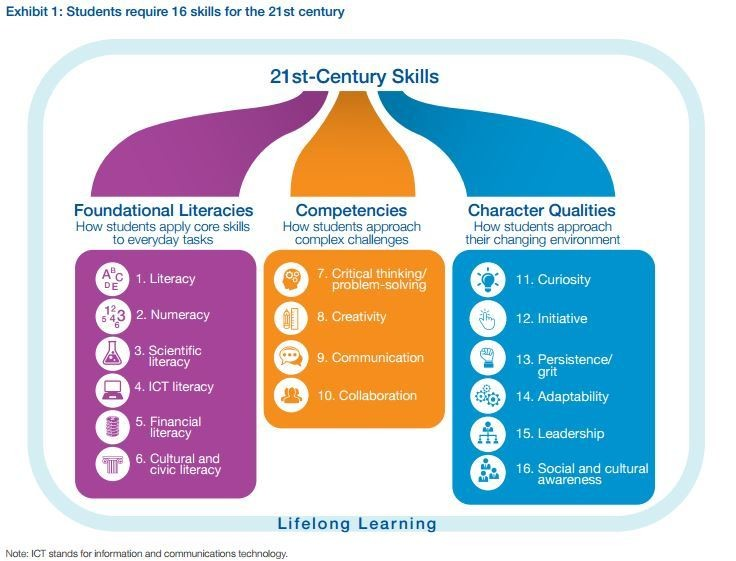
Source: World Economic Forum, New Vision for Education (2016)
PRINCIPLES FOR A 21ST CENTURY UNIVERSITY CURRICULUM There is still some debate on what the purpose of higher education is. Some argue that higher education is solely for preparing graduates for specific careers, which we view as very narrow, and less useful as these careers are changing faster than education. Others argue that education is the pursuit of knowledge and wisdom for their own sake. At Minerva, we champion a third path, a view proposed by Benjamin Franklin and Thomas Jefferson more than two centuries ago. Their view advocates usefulness or “practical” knowledge; knowledge acquired to serve the country and humankind. We believe this view as increasingly relevant for the 21st century, even if our understanding of what is useful or practical has evolved in the last 200 years. In designing the curriculum to impart 21st century skills to students, Minerva has relied on essential principles:- Content is not the focus: content is increasingly ubiquitous and (almost) free. Thus, it is not the role of the university to ask students to memorize freely available content. We use the “flipped classroom” approach, where students are expected to acquire most of the content on their own. The skills that students learn are not about memorizing the content, but knowing where to find it, how to evaluate it, and what to do with it.
- Students need informed choice: Most students do not have a very clear idea of what they want to do after graduation and may make premature choices as required by their universities. At Minerva, all students take the same four foundational courses the first year and will only choose their major in the middle of their second year. These four courses are:
- Formal Analyses (which focuses on core aspects of critical thinking),
- Empirical Analyses (which focuses on core aspects of creative thinking),
- Multimodal Communication (which focuses on core aspects of effective communication), and
- Complex Systems (which focuses on core aspects of effective interrelation).
- Active learning, not passive listening: At Minerva, we do not have lectures. Stephen Kosslyn described lectures as a great tool for teaching, yet a terrible one for learning. At Minerva, our classes are all seminar-based. Faculty act as facilitators, setting the context, and speaking less than 15% of the time. Students take charge, and engage in debates, polls, and collaborate on the material.
- Students need to be immersed in the world instead of leading a sequestered life on campus: In each of the seven cities we mentioned at the beginning of the article, students engage in various experiential programs, including community projects, working with local businesses and government agencies, and student-centric activities like communal meals, club meetings, and hackathons. These programs incorporate individual coaching and are closely integrated with academics, so students receive formative feedback across multiple dimensions, including professionalism, self-management, cultural dexterity, personal responsibility, and interpersonal engagement. This global cultural immersion is only possible if the formal academic education is delivered virtually.
- Embracing practical knowledge: students are encouraged and supported in seeking internship opportunities from their first year on to their graduation. Feedback from their managers is an informal part of their assessment process.
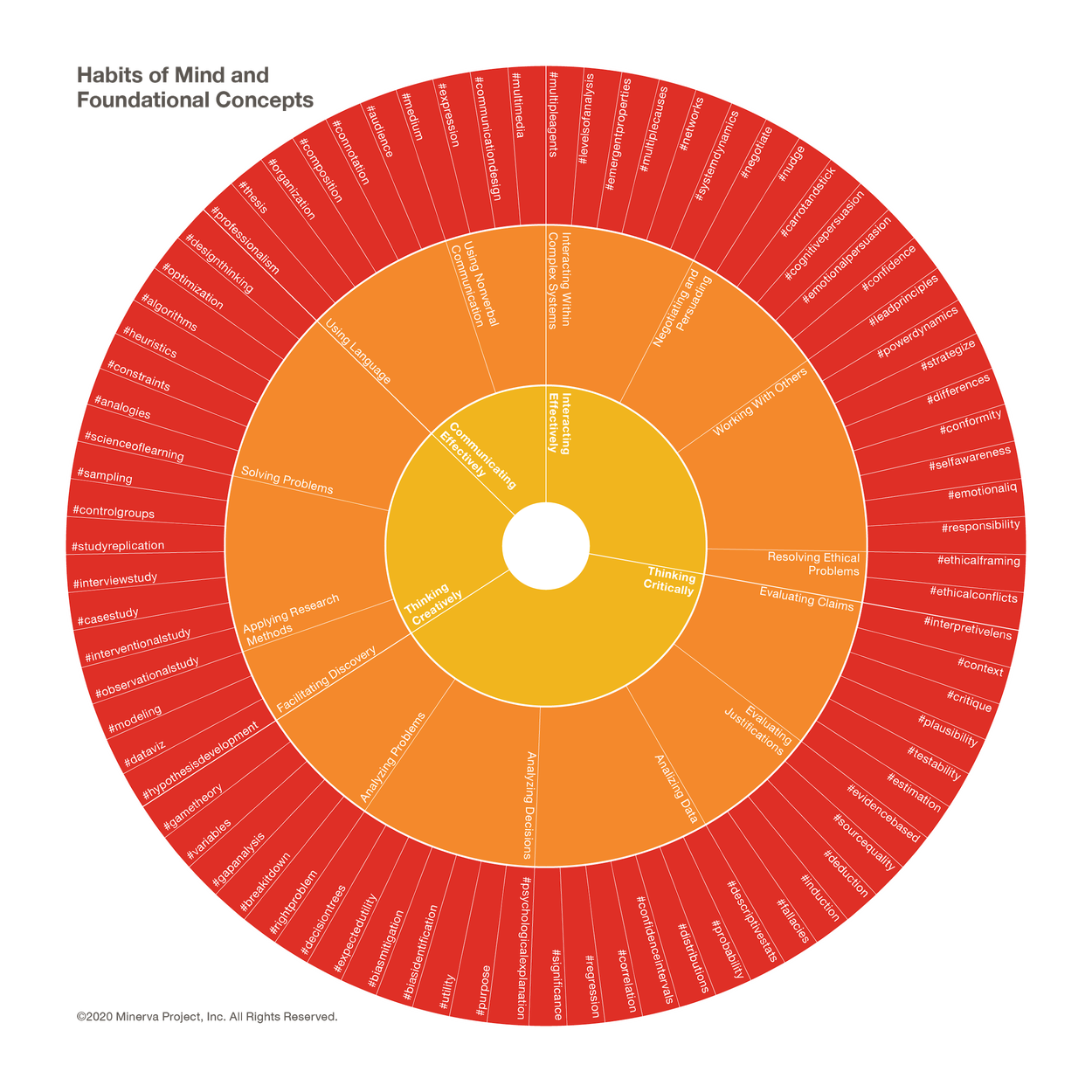 Minerva identifies four core competencies: critical thinking, creative thinking, effective collaboration, and effective interrelation. To teach these core competencies, we break them down into “habits of mind” and “foundational concepts.” “Habits of mind” include cognitive skills that will become automatic with the right triggers. “Foundational concepts“ include broadly applicable fundamental knowledge. All of the four core competencies draw on both types. For example, we can break down effective interrelation to several habits of mind and foundational concepts. These habits and concepts will become the learning objectives for each class:
- Negotiating, mediating, and persuading, which relies on “preparing multidimensional best alternatives to a negotiated agreement.”
- Working effectively with others, which relies on “learning to assign team roles appropriately, which requires being sensitive to the nature of the task and specific roles.”
- Resolving ethical dilemmas and having social consciousness, which relies on“evaluating ethical dilemmas and framing the dilemma in a way to resolve it.”
- Interacting with complex systems, which relies on “identifying emergent properties and dynamics of complex systems.”