
Social Rental Housing is a housing alternative in which the State, in partnership with the private sector or not, offers affordable housing through the payment of rent and/or fees, with or without subsidies, without transferring ownership to the beneficiary.
Social rental programs seek to support mainly low-income families who spend a large portion of their income on housing, or people who can make monthly payments but who, without external assistance, would not be able to access the formal rental market—for example, because they do not have formal or regular income.
In Brazil, families earning up to three minimum wages (i.e., up to R$4,500—approximately US$800) and spending more than 30% of this income on housing-related costs (rent and expenses such as condominium fees and energy or water bills) are in a situation called “excessive rental burden.” According to the Fundação João Pinheiro (2024), this situation accounts for more than half of the country's housing deficit (52.2% of the 6.2 million homes). The vast majority of households that are in a situation of excessive rent burden have a monthly family income of less than R$2,850, or US$500 (85.2%), and are headed by women (64.2%) and black and brown people (60.4%).
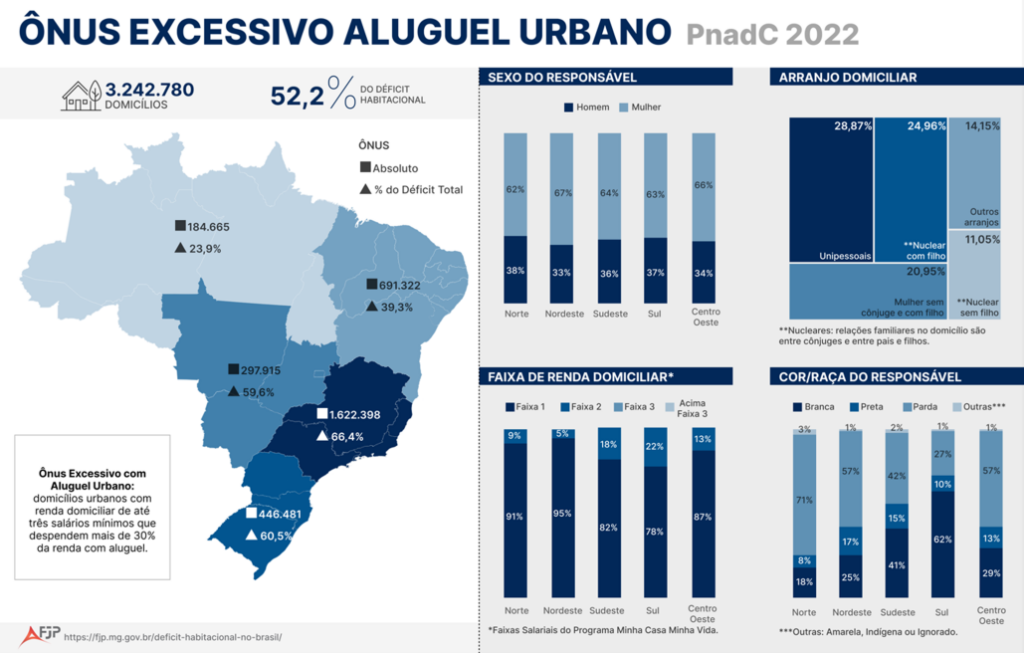 Source: João Pinheiro Foundation
To address this situation, the Inter-American Development Bank (IDB) is working with actors at different levels of government to develop new instruments. At the national level, social leasing is part of the areas for improvement in policies for habitação de interesse social analisadas na collection “Habitação de Interesse Social no Brasil”, including diagnostic elements and a specific volume with “Propostas sobre Locação Social”, in partnership with the IDB and the Federal Government. In 2023, social leasing was integrated into the reformulation of the program. Minha Casa, Minha Vida, and the IDB supported the Ministry of Cities in operationalizing the approach in concrete programs, using a working methodology called MESA.
 Source: IDB and National Housing Secretariat, 2021
At the subnational level, the city of Recife stands out for including Social Rentals as a new axis of service in its Municipal Housing Policy. In this axis has a component that supports the supply of new apartments for rent through a Public-Private Partnership (PPP) established by Lei No 19.175/2023. This partnership builds or renovates housing units on lots and in buildings provided by the municipality and then manages them.
There is also a component to support demand, i.e., low-income families with difficulties in accessing the rental market. With “Tô em Casa” Program, established by Law No 18.967/2022, these families receive a voucher to pay part of the rent directly to the landlord by the Municipal Government. Thus, the rent is divided between the public agency, which offers the voucher, and the beneficiary families or individuals, who supplement the payment with up to 25% of their monthly family income.
There are two specific groups of beneficiaries: people living in homes without masonry or wooden walls (rustic homes) located in areas of municipal intervention; and people subject to excessive rent burdens and involuntary cohabitation. The amount of the subsidy varies according to family income, according to the calculation presented in the Decreto Nº 35.925/2022.
The voucher program design was supported by the IDB as part of the credit operation. Promorar Recife, and included the analysis of other similar initiatives inside and outside Brazil, always considering local particularities. The pilot phase, carried out in 2023 and focused specifically on supporting single mothers, has already shown results, as reported by Jaqueline, one of the residents who used the new voucher program:
"Here in this property, my daughters and I finally have the ideal space to live and the privacy they need."
Before moving, Jaqueline paid R$700 per month to rent a room where she lived with her two daughters, next to a bar in Recife’s west side. With a low family income, she also turned the house into a workplace, serving customers who sought her hairdressing and manicure services. Now, with the monthly support of the subsidy offered by the Recife Municipal Government, she was able to find a three-bedroom property in the same neighborhood, and her contribution to the rent for the new home is significantly lower.
“With the Municipal Government’s help, I now only pay $300 a month to cover the $800 monthly rent,” says Jaqueline as she sets up her beauty salon on the terrace of her new rented property.
Social support is also a key feature of the program. Supporting families throughout the process, searching for properties, conducting technical inspections, and ensuring that payments are made regularly are some of the essential elements for the program's success. A specialized company was selected through a bidding process to plan, execute, and monitor all these Stages.
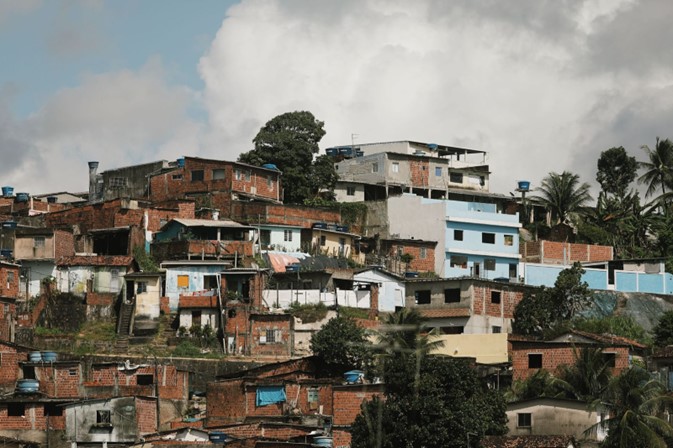
The voucher will be implemented gradually, through public calls based on social vulnerability criteria. The goal is for the program to provide subsidies to approximately 1,200 families in the next 4 years, becoming an important tool for reducing the housing deficit in Recife.
Reducing monthly housing costs for families while providing adequate housing are the main objectives of the social rental program, an initiative that aims to multiply stories like Jaqueline's.