
Today, only a handful of people call Santa Rosa de Tastil home. However, this tiny settlement in the Andean foothills is only beginning to divulge a monumental past. This was once the site of the largest pre-Columbian city in the territory of present-day Argentina. In the 15th century, prosperous Tastil boasted more than 2,000 inhabitants.
By the time the Spaniards arrived, however, the city lay abandoned. The reasons are murky; some studies suggest that the inhabitants ran out of water or were displaced to other cities. But the secrets of Tastil could soon be uncovered by the area’s residents, who – backed by the provincial government, local stakeholders, and IDB financing – are in the process of reclaiming their heritage.
"In all of the surroundings of Tastil, where the Inca sites are, we have found buildings and ceramics in the Tastil style, so what I postulate is that the Incas dismantled this city. That is, they redistributed the population to other places as workers, which was a frequent practice then,” says Christian Vitry, director of the Qhapaq Ñan Program in Argentina’s northwest Salta Province.
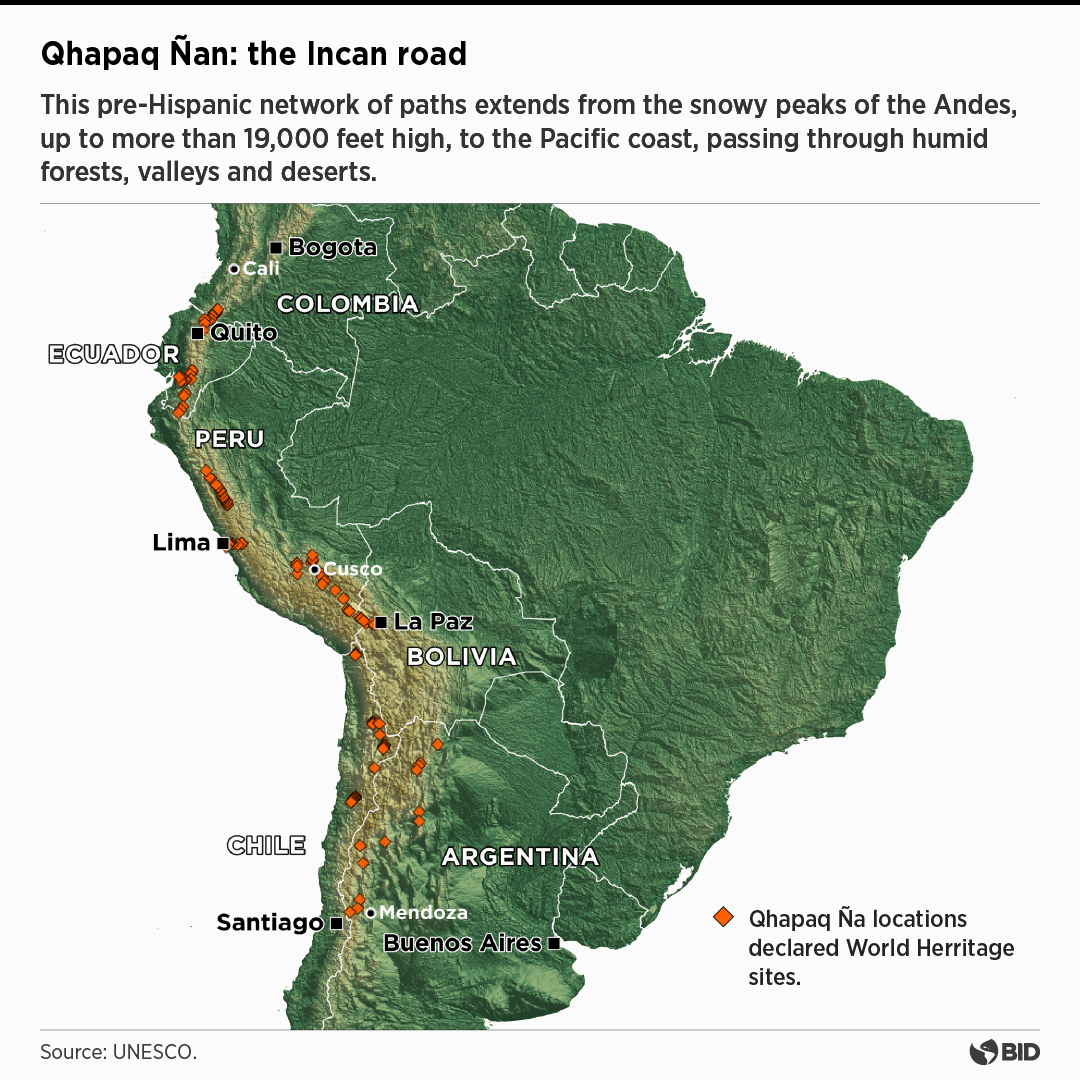
Tastil was probably one of the cities along the Qhapaq Ñan, or Inca Trail, the network of roads that the Incas created to connect production centers and ritualistic sites across more than 40,000 kilometers (crossing the territories of present-day Colombia, Ecuador, Peru, Bolivia, Chile and Argentina). The cultural and historical value of the Trail prompted UNESCO to declare it a World Heritage Site in 2014.
"Unprecedented work is being done here,” says Vitry. “The first intervention that this site had was in 1969 … and now, 50 years later, we are performing tasks to conserve and safeguard it."
The efforts have confirmed the scale and importance of Tastil; the city occupied approximately 18 hectares, with more than 1,200 enclosures or housing spaces. Workers have identified main and secondary streets, corrals, spaces for public meetings, cemeteries and more than 6,000 rocks that contain rock art. That discovery could make Tastil one of the most important sites for pre-Columbian art in South America.
Tastil might have also been an key commercial and communications center on the Inca Trail: "We have found seashells from the Pacific Ocean, which is far away. We have even found peanut seeds, which are only grown in warm areas. There are a large number of llama skeletons, which the Incas used for transportation and to carry food and wool,” Vitry reports. "It was like a first small globalization. Suddenly, here in Tastil, they learned that there were people in Colombia, in Ecuador ... It was an opening of communication with the continent."
Meet Valentina Chuchuy, one of the young custodians of the Inca Road in Salta, Argentina
It is the human impact of the initiative, however, that caught the attention of Joseph Milewski, team leader at the IDB. Today, the Bank is financing the work at Tastil through its sustainable tourism program for Salta.
"Our responsibility is to improve lives. In this case, there was the capacity and willingness on all sides to work directly with the people, and it was much more efficient, in terms of the economic and social impact, to work directly with the local population," says Milewski.
Unlike the work of half a century ago, archaeological conservation is being carried out hand-in-hand with local residents. The government of Salta, supported by the IDB, is working in an unprecedented arrangement with local associations, including the tourism association, community groups and individuals.
For Primitivo Yapura of the Turuyaco Association, an organization that provides accommodation, food and transfers for the workers on the site, participating in the project transcends archaeological discovery. "For us, realizing this project is a source of pride, because our ancestors, years ago, placed these stones to develop their city, to live ... The fact that today, this generation again is touching these stones ... that is something that has become part of the the history of this site," he says.
Local communities selected 15 people, mostly youths, to work in the field. Under the direction of professional archaeologists, they received scholarships and were trained in pre-Hispanic building techniques to perform conservation tasks.
"At this moment, we are doing restoration. There are many collapsed structures, either caused by people or by climatic factors," says Daniel Arjona, one of the young people working in Tastil. "The truth is that I never thought I would be here.”
"The interesting thing about these young people is that even though they come from very isolated places, they are extraordinarily focused on their work. They work with vivacity, joy and technical capacity that has surprised everyone," says Milewski. "We do not always need to hire companies. We can also work directly with the beneficiaries."
This year, the successful approach developed in Tastil will be replicated in other archaeological sites along the Inca Trail in Salta, such as the Calchaquí Valley.
Many of the young people working on the Tastil project have expressed interest in continuing to study archeology or to work in related areas, such as cultural-heritage management or tourism. The experience, in a sense, has not only uncovered the past, but may have created a bridge to the future.
Learn more about cultural patrimony and the IDB’s work in our Sustainable Cities blog.