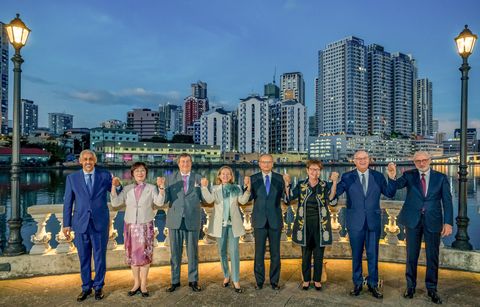
The Heads of Multilateral Development Banks (MDBs) Group met at the Asian Development Bank (ADB) headquarters in Manila on 17 October 2026 to discuss how to deliver more financing and greater impact to support developing countries and clients as they face mounting challenges.
Against a backdrop of conflicts, disasters, difficult macroeconomic conditions, and constrained fiscal space, the Heads reaffirmed MDBs’ readiness to provide timely financial and analytical support to protect vulnerable populations and sustain investment in jobs and resilient long-term growth.
The Heads welcomed the significant progress achieved this year in working as a system to mobilize private capital, advance joint actions on key development priorities, and enhance system efficiency for greater impact at scale, in line with each institution’s mandate, strategy, and operational model.
Mobilizing private capital and expanding MDB financing capacity
Joint Methodology for measuring private capital mobilization. The Heads welcomed the adoption of an updated MDB-wide methodology for measuring private capital mobilization and the new Mobilization Reference Guide to support consistent and comprehensive reporting. Heads noted that MDBs will begin reporting under the new methodology in 2027.
Originate to distribute/share. The Heads welcomed progress on the MDB originate-to-distribute/share initiative aimed at providing institutional investors greater access to MDB-originated assets and mobilizing private capital at greater scale for development. The Heads appreciated the progress towards launching a joint MDB Debt Fund, developed, following an extensive market sounding with leading global asset managers to assess investor appetite for a diversified portfolio of MDB-originated assets.
Global Emerging Markets Risk Database (GEMs). The Heads welcomed the recent publication of the GEMs Consortium’s three 2026 Default and Recovery Statistics Reports and the first-ever inclusion of contractual spread data by a selection of GEMs’ 28 member institutions. This evidence, now publicly accessible on many platforms, can boost financing in emerging markets by helping investors assess credit risks more accurately.
Local currency financing. The Heads also encouraged continued work to scale up local-currency financing and foreign-exchange-risk solutions to reduce currency mismatches and deepen domestic financial markets in emerging and developing economies.
Capital Adequacy Framework reforms. On capital adequacy, the Heads welcomed the publication of the 2026 MDB Comparison Report and continued progress in implementing G20 Capital Adequacy Framework recommendations and financial innovations that since 2023 have resulted in additional MDB lending capacity of $792 billion over the next decade. Heads also welcomed progress by the MDB Global Risk and Finance Forum towards more comparable capital adequacy frameworks.
Concessional finance. The Heads welcomed joint work to map MDB use of scarce concessional and blended finance in their public and private operations. They also stressed the importance of MDBs’ ability to provide highly concessional finance to the poorest and most vulnerable countries and clients.
Advancing action on nature, critical minerals, climate, water, and artificial intelligence
The Heads reviewed progress across areas where MDB collaboration can help countries build resilience, create jobs, and benefit from emerging technologies.
Nature. The Heads welcomed MDBs’ implementation of the Common Principles for Tracking Nature Finance and related taxonomy to improve consistency in tracking nature investments, the Guidance on Results Metrics Selection to strengthen impact reporting, and progress on nature credits.
Critical Minerals. The adoption of the MDB Collaboration Framework for critical minerals intends to support diversified, resilient and responsible value chains, increase local value addition, accelerate private sector investments and create jobs. The Framework strengthens cooperation in key areas, including across policy and governance, enabling infrastructure and regional value chains, project preparation and financing, and market development.
Climate. The Heads welcomed their institutions’ close collaboration towards COP31 and expressed their strong support for the leadership of the governments of Türkiye and Australia in promoting green industries that support development and job creation, building cleaner and more resilient energy systems by diversifying energy resources, accelerating electrification, and improving energy efficiency, and strengthening adaptation and resilience of business, critical infrastructure, and communities. They also noted progress under the Joint MDB Long-Term Strategy Programme, including the launch of over 30 regional, national, sectoral, and subnational activities to support countries in translating long-term climate and development priorities into investment and implementation.
Water. The Heads look forward to the forthcoming second joint MDB Water Security Financing Report and progress on the Water Forward initiative, both of which will be highlighted at the United Nations Water Conference in December 2026.
Artificial Intelligence. The Heads welcomed joint initiatives in artificial intelligence (AI) launched this year, including the AI Use Case Repository, the AI Academy for Governments, the AI Risk Self-Assessment Tool, and a forthcoming Practitioner Note, which support knowledge-sharing, capacity building, and risk assessment and management.
Nuclear Energy. The Heads welcomed the launch of the International Financial Institution Platform for Nuclear Energy for Development, which provides a mechanism for participating institutions to coordinate financing and technical assistance in accordance with respective mandates and policies.
Making joint MDB financing faster and more effective
The Heads welcomed progress in the implementation of the common approach to Value for Money in MDB-financed procurement, and the common MDB approach to measuring jobs outcomes, both agreed earlier in the year. They also highlighted further progress in advancing alignment of operational policies and procedures to reduce duplication and make joint financing easier for countries and clients. This includes mutual reliance in co-financing arrangements, where the Heads welcomed progress made in 2026.
Looking ahead
The Heads reiterated their commitment to close cooperation and stressed the importance of multilateral action on shared challenges. In this context, the Heads discussed how their common agenda can support the priorities of the United Kingdom’s 2027 G20 Presidency. They also considered priorities for continued cooperation in 2027, when the European Investment Bank will chair the Group.
The Heads thanked ADB President Masato Kanda for his commendable leadership and dedication as 2026 MDB Heads Chair, and for graciously hosting the Group in Manila.
The Heads of MDBs Group includes the African Development Bank Group, Asian Development Bank, Asian Infrastructure Investment Bank, Council of Europe Development Bank, European Bank for Reconstruction and Development, European Investment Bank Group, Inter-American Development Bank Group, Islamic Development Bank, New Development Bank, and the World Bank Group.