
The risk of dying from Covid-19 is significantly lowerfor young and middle-aged adults than for the elderly. The fact that Latin America’s population is youngerrelative to high-income regions would suggest that age-based prioritization of vaccine delivery, targeted confinement, and other policies targeting those most at risk of developing serious complicationswould be especially cost-effective. Put another way, making sure the elderly receive the vaccine first and thatthey stay at home until it arrives, while the younger population is allowed to go about its business, are better propositions in, say, Mexico than Canada.
But is Latin America’s younger population really an advantage in the fight to contain the coronavirus? The answer is: not nearly as much as previously thought.
In a recent working paper, we show that in developing countries younger age groups represent a significantly larger share of Covid-19 deaths relative to high-income countries. From the five developing countries with the most confirmed Covid-19 deaths, four are in Latin America. In this region, young and middle-age adults represent a larger share of each country’s deaths than those cohorts do in the five high-income countries with the highest number of deaths (Figure 1). For example, for every 100 Covid-19 deaths in Colombia around 30 were people under 60 years old. Just 12 of every 100 Covid-19 deaths in the US correspond to people under 60.
Figure 1. Shares of 10-Year Age Groups in Total Country-Level Covid-19 Deaths for 10 of the Countries with the Highest Death Toll
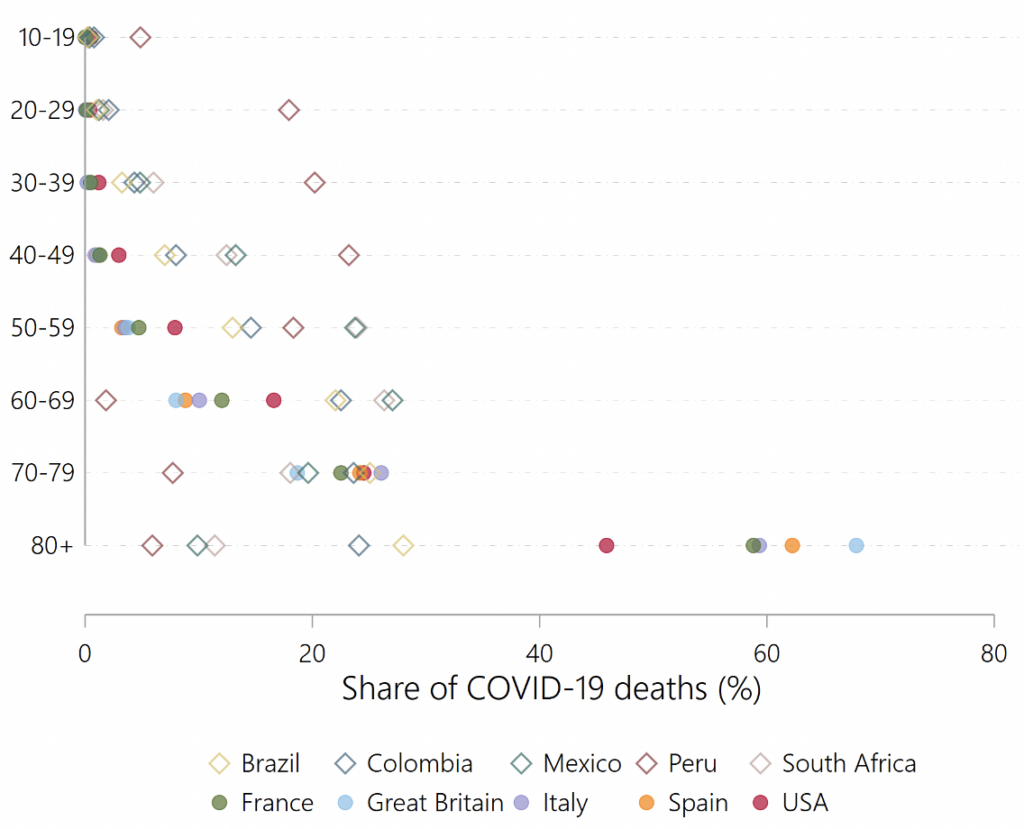 Note:Data on Covid-19 deaths by age group and country were collected by the authors from official, publicly available sources. They include the top 5 high-income countries and the top 5 developing countries in terms of the number of confirmed Covid-19 deaths, excluding Russia for whom the information was not available by age group. Developing countries are plotted with hollow diamonds and high-income countries are plotted with solid dots. The age group younger than 10 is excluded from all calculations because they represent only a slim fraction of Covid-19 deaths in all countries. All shares are calculated over the population 10 and older, such that a country’s markers across all age groups add up to 100%.
 Lower Recovery Rates
Why the difference?The first possible explanation is that populations in developing countries tend to be younger, which would mean that the pool of people that is susceptible to get the disease is also younger. However, even if we account for differences in ages across the two country groups, the share of non-elderly groups in Covid-19 deaths remains significantly larger in developing than in high-income countries.
If the larger number of susceptible young people in developing countries is not driving the gap, this leaves two other possible explanations: higher infection rates among Latin American young and middle-aged adults, lower recovery rates, or a combination of both. Put differently, it could be thatyounger adults in developing countries are more likely to become infected than those in rich countries, or it could be that, once infected, they are more likely to die from the disease in low- and middle-income countries than their peers in high-income countries.
Our research found that younger populations are relatively less likely to recover from Covid-19 in developing than in rich countries. Non-elderly Covid-19 patients are more likely to die from the disease in Mexico and Colombia than they are in the US and Canada, whereas there are no significant differences among the population aged 80 and older (Figure 2). In fact, the average Covid-19 positive patient in the 40-49 age group in the Colombia and Mexico sample has statistically the same average probability of dying from Covid-19 as a Covid-19 positive patient in the 60-69 age group in Canada or the US.
Figure 2. Probabilities of Death, Hospitalization, and Placement in an ICU for Covid-19 Positive Patients in Colombia, Mexico, Canada and the United States
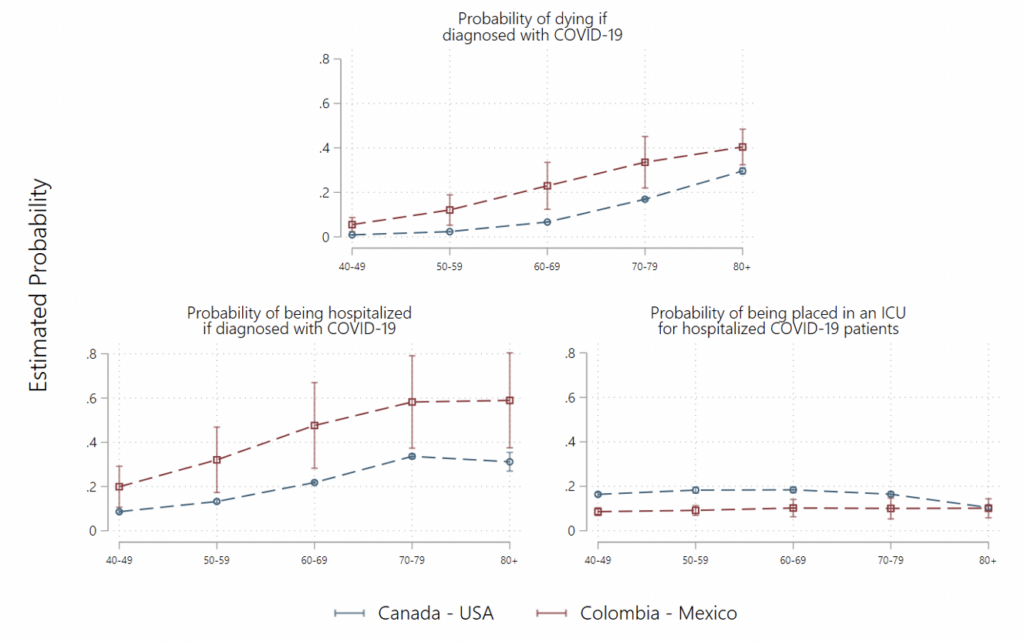 Note: Author’s calculations from anonymized patient-level data from official sources for Colombia, Mexico, Canada and USA. These data capture all positive Covid-19 diagnoses regardless of hospitalization status. The number of individuals in the data for each country, respectively, is 72.846, 193.715, 64.585 and 1.039.044. Plots show estimated conditional probabilities and 95% confidence intervals obtained from probit regressions. Robust standard errors are clustered at the country level. Separately for developing (Colombia and Mexico) and high-income (Canada and USA) countries, the figure shows the conditional probability of death given a Covid-19 diagnosis by age group (top), the conditional probability of hospitalization given Covid-19 diagnosis by age group (bottom-left), and the conditional probability of placement in an ICU given hospitalization and a Covid-19 diagnosis (bottom-right).
 So why are young people in Latin America less likely to recover from the coronavirus? Part of the difference is access to care for patients in critical condition. It is true that in Colombia, and even more so in Mexico, patients that receive a positive Covid-19 diagnosis are more likely to be hospitalized than in Canada and the US. However, younger Covid-19 patients in these countries have a lower probability of being placed in an Intensive Care Unit (ICU) if they are hospitalized.Our analysis suggests that this not because young and middle-age patients in Mexico and Colombia need less intensive care. Quite the contrary, they tend to develop more severe complications from the disease than people of the same age in Canada and the US. The relatively lower access to ICU care appears to reflect a more limited supply of such services in these Latin American countries.
Another driver of lower recovery rates of the non-elderly in developing countries is the prevalence of preexisting conditions that may lead to more severe Covid-19 complications. To reach this conclusion, we first computed simple average shares in Covid-19 deaths for different age groups in 31 countries, of which 13 were developing countries. We found that, in developing countries, those aged 20 to 39 account for a 5 percentage points higher share of Covid-19 deaths than those in high-income countries, and those aged 40 to 50 account for a 23 percentage points higher share of their countries’ Covid-19 deaths (Figure 3, top).
Next, we compared other characteristics that could affect mortality rates, such as income, population, total number of Covid-19 cases and deaths, the population’s age composition, testing per capita, positivity rates of tests, and the number of days that each country took to issue stay-at-home orders and to close schools following initial reported cases. The gap in shares between developing and rich countries shrinks when we account for these factors, but only by little, indicating that they cannot account for the bulk of the mortality differences between the young in developing and high-income countries (Figure 3, bottom-left).
Last, we repeated the exercise accounting for the share of each country’s population at high risk of developing severe Covid-19 complications due to preexisting conditions at the age-group level, obtained from a recent scientific article. The gap between developing and rich countries disappears completely for the young adult group, and shrinks significantly (from 23 to 12 percentage points) for middle-aged adults (Figure 3, bottom-right).The higher prevalence of preexisting conditions associated with severe Covid-19 complications — such as chronic kidney diseases, chronic neurological disorders, HIV/AIDs, and tuberculosis — explains much of the higher non-elderly mortality observed in developing countries.
Figure 3. Estimates of the Age-Group Shares in Covid-19 Deaths in Developing and High-Income Countries
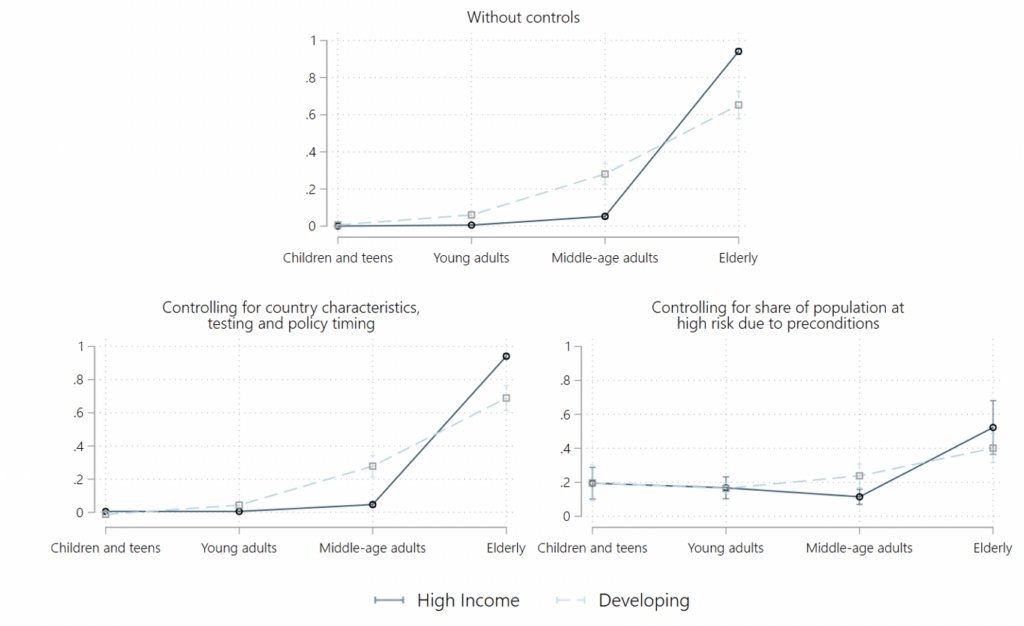 Note: Covid-19 mortality data by age group collected by the authors for 18 high-income and 13 developing countries as of July 2020. Age groups are defined as follows: Children and teens, ages 0-19; Young adults, ages 20-39; Middle-aged adults, ages 40-59; older adults, ages 60+. Figure shows estimated shares and 95% confidence intervals of each age group in Covid-19 deaths, separately for high-income countries and developing countries. Robust standard errors are clustered at the country level. The top panel shows raw estimated age-group shares for each group of countries. The bottom left panel adds controls for country characteristics (GDP per capita, country population, the total number of Covid-19 cases, the total number of Covid-19 deaths), testing (the number of tests per capita and the positivity rate of these tests at the time of data collection), and policy timing (the number of days between the first confirmed case in the country and school closures, and the number of days between the first case and the issue of stay-at-home orders). In addition to these variables, the bottom-right panel also controls for the share of the population in each age group and country that is at high risk due to preexisting conditions that are associated with severe Covid-19 disease.
 HigherInfection Rates
After accounting for all these factors, middle-aged adults still represent a meaningfully larger share of Covid-19 deaths in developing than in high-income countries. This remaining gap is likely explained by differences in the rate at which middle-aged adults become infected with the disease.We find indirect evidence supporting this explanation by examining data from over 1,400 Brazilian cities.Variables that other studies have linked to a faster spread of the disease — such as residential overcrowding, access to piped water, and labor market informality — are also linked to a larger share of the non-elderly population in the total Covid-19 deaths of each city.Other studies, including a large serological survey that infers the spread of the disease by measuring the presence of antibodies in the local population of 133 Brazilian cities, similarly point in the direction of increased infection rates among this age group.
The development challenges of Latin America and the Caribbean—and in particular the high prevalence of morbidities and the limitations of our healthcare services—have made young and middle-aged adults in our region more vulnerable to Covid-19 than in other parts of the world.Does this mean that policies such as age-based vaccine prioritization and targeted confinements may be less effective in our countries?Not necessarily.But our work does highlight that, in the developing world, age may not be a sufficient indicator of Covid-19 mortality risk. Our response to the crisis needs to pay special attention to other factors—such as preexisting conditions, housing conditions, and access to healthcare—to protect lives as we move towards much-needed economic recovery.