
- An IMIPAS scientific expedition, funded by the IDB, reveals that sargassum in the Mexican Caribbean could be nearly three times higher than previously estimated, opening a major opportunity for sustainable management.
- The expedition documented more than 870 organisms per kilogram of sargassum in open waters and warns that indiscriminate removal without ecological criteria can destroy critical habitats for Caribbean fishery species.
- Based on the expedition’s findings, Mexico has become the first country in the world to officially declare sargassum a fishery resource, opening the door to an emerging industry for coastal communities.
Every year, millions of tons of sargassum inundate the coasts of the Mexican Caribbean. This type of seaweed smothers coral reefs, disrupts tourism, and hits economies that depend on the sea. What began as an unusual phenomenon in 2011 has become a structural challenge. However, an unprecedented scientific expedition has just reshaped how the problem is understood. In May 2025, the JCFIMP2505 research cruise, carried out aboard the Dr. Jorge Carranza Fraser vessel, revealed that the actual amount of sargassum in open waters could be nearly three times higher than previously estimated. This finding not only redefines the scale of the challenge, but also opens the door to its sustainable use.
This first comprehensive assessment of pelagic sargassum in the Mexican Caribbean’s Exclusive Economic Zone was funded by the Inter‑American Development Bank (IDB) and carried out by the Mexican Institute for Sustainable Fisheries and Aquaculture Research (IMIPAS).

In just two weeks, the expedition covered 1,920 nautical miles, established 48 oceanographic stations, and recorded 982 sargassum aggregations along 17 transects perpendicular to the coast. The key finding was not only the extent of the sargassum, but its actual weight. For years, global estimates have relied on a standard factor of 3.34 kg/m², derived mainly from studies in the Sargasso Sea. This value became the universal parameter for converting satellite imagery into biomass tonnage. However, it had never been verified for the Mexican Caribbean.
The expedition did what was essential: it collected sargassum directly from floating mats and weighed it. The results were striking. Wet weight ranged from 3.21 to 17.96 kg/m², with an average of 9.76 kg/m² — nearly three times the historically used value. When these measurements were applied to satellite-detected areas, the difference from previous estimates amounted to 56 million tons. This is not a minor adjustment, but a radical shift in the scale of the problem and, consequently, in the scale of the solutions required.
A Floating Ecosystem with Ecological Value
The scientific expedition also found that sargassum rafts are not merely masses of algae, but function as floating ecosystems that support remarkable biodiversity. The expedition documented more than 870 organisms per kilogram of sargassum, dominated by arthropods, which account for over 80% of the associated fauna. Species identified included the shrimp Latreutes fucorum, the crab Portunus sayi, and juvenile fish of commercial interest.
These findings have direct implications for management: indiscriminate removal of sargassum can eliminate critical habitats for fishery species. As a result, any strategy to harvest or use sargassum must incorporate ecological criteria and responsible management protocols.
The expedition also revealed significant chemical variations. Phosphorus content, for example, varies by species and location. Sargassum cf. fluitans III showed phosphorus concentrations of up to 0.5% — four times higher than other varieties — possibly influenced by ocean upwelling south of Cozumel. This suggests that strategic harvesting could maximize its value as an agricultural input.
Overall, sargassum from the Mexican Caribbean contains around 20% carbon, 0.35–0.42% nitrogen, and in some cases high levels of phosphorus. These are precisely the key macronutrients for agriculture. An organic fertilizer derived from sargassum could supply NPK, micronutrients, and organic matter, improving soil fertility and structure.
But the potential goes much further. Sargassum is rich in alginates and fucoidans — polysaccharides used in the food, pharmaceutical, and cosmetics industries. Alginates are employed as thickeners, matrices for controlled drug release, and materials for 3D bioprinting. Fucoidans have shown anticoagulant, antiviral, and antitumor properties in preclinical studies. In addition, its high carbon content makes sargassum a candidate for biogas, biochar, and other circular economy and carbon capture solutions.
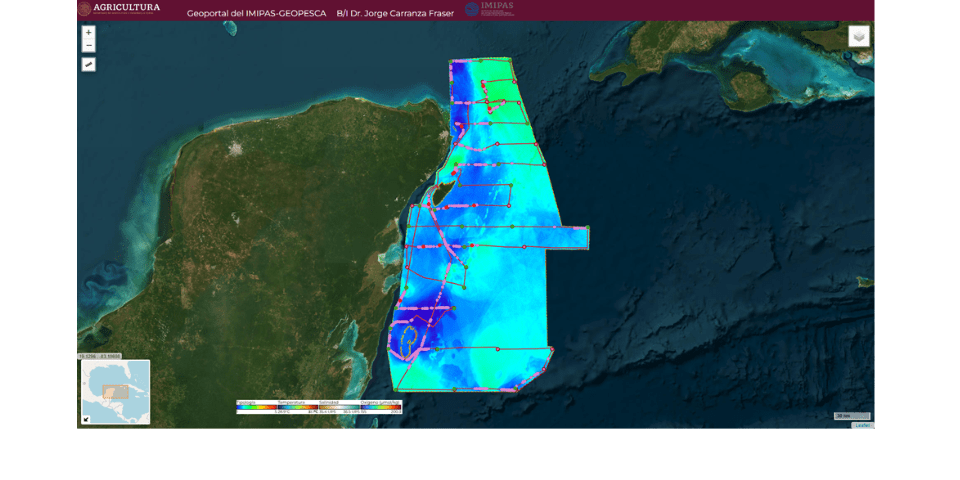
Another key advance was the development of predictive models based on machine learning. Using Random Forest algorithms with spatial cross‑validation, scientists integrated oceanographic variables such as currents, thermocline and oxycline depth, and geographic location. The results confirmed patterns long observed by local fishers: the Yucatán and Cayman currents are the main pathways transporting sargassum toward Mexico, with peak arrivals between April and September.
Some of this information is already being integrated into the institutional geoportal GEOPESCA. At the same time, IMIPAS continues to work on identifying transport routes that would allow sargassum to be intercepted in open waters, where its economic value is higher and its environmental impact is lower.
From Invasive Algae to a Fishery Resource
Sargassum, once seen only as an environmental and economic burden, is increasingly being reimagined as a valuable resource. In Mexico, its inclusion in the National Fisheries Charter marks a significant step toward recognizing its potential within the fisheries sector and enabling its regulated use.
Across the Caribbean, efforts are also underway to transform this invasive algae into inputs for productive sectors such as agriculture, construction, and energy, creating new value chains while reducing the costs associated with its accumulation. However, scaling these solutions requires overcoming key challenges, including the presence of heavy metals and other contaminants that limit its safe use.
In this context, innovation is playing a critical role. For example, researchers from the Instituto Tecnológico de Santo Domingo (INTEC), in collaboration with private partners and the IDB, have developed methods to generate energy from sargassum while separating the arsenic contained in the algae. Advances like these illustrate how technological solutions can address key barriers and expand opportunities for the sustainable use of sargassum across the region.
The IDB’s commitment to sargassum extends beyond Mexico and goes far beyond the generation of scientific data. Through project RG‑T4374, “Integrated Sargassum Management for the Greater Caribbean,” the Bank is promoting a regional approach aimed at transforming this environmental crisis into an economic opportunity for more than 20 affected countries—strengthening capacities, fostering technological innovation, and supporting regulatory frameworks tailored to each context. The scientific protocols, predictive models, and regulatory approaches developed in the Mexican Caribbean provide the foundation for a management system that can be replicated at the regional level.
The next phases are exploring integrated monitoring systems using sensors and smart buoys, regional laboratory networks to certify quality and heavy metal content, and harmonized regulatory frameworks. Innovative financial mechanisms are also being assessed—including parametric insurance, co‑financing with the tourism sector, and advance purchase agreements — to turn sargassum into a bankable asset rather than an environmental liability.
Mexico’s experience shows that transforming an environmental problem into an economic opportunity requires three elements: rigorous science, political will, and smart financial architecture.
Sargassum will continue to arrive — but the Caribbean no longer has to resign itself to being a victim. It can choose to be a pioneer.