Nuestro equipo directivo
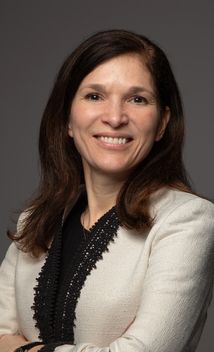
Laura Alfaro Maykall es economista jefe y consejera económica del Banco Interamericano de Desarrollo (BID). Asumió este cargo el 1 de junio de 2025, tras tomar una licencia de la Harvard Business School, donde es profesora Warren Alpert de Administración de Empresas.
Se desempeñó como ministra de Planificación Nacional y Política Económica en Costa Rica entre 2010 y 2012. Es co-editora del Journal of International Economics y del World Bank Research Observer, presidenta de la Asociación de Economía de América Latina y el Caribe (LACEA) y asociada de investigación en el Center for Economic and Policy Research (CEPR) y en el National Bureau of Economic Research (NBER).
La Sra. Alfaro Maykall ha escrito numerosos artículos sobre economía internacional, flujos de capital, inversión extranjera directa (IED), deuda soberana y comercio. Obtuvo su doctorado en Economía en la Universidad de California en Los Ángeles (UCLA), donde recibió el premio Dissertation Fellowship. También obtuvo una licenciatura en Economía en la Universidad de Costa Rica y una Licenciatura en la Pontificia Universidad Católica de Chile. La Sra. Laura Alfaro Maykall es ciudadana de Costa Rica y de los Estados Unidos.
Últimos estudios en el BID
(Disponibles en inglés)
Multinational corporations (MNCs) are the dominant institutions for creating and distributing knowledge across borders. Their activities generate geopolitical externalities when cross-border knowledge spillovers enhance a rival states strategic capabilities in ways neither internalized by firms nor priced by markets. This review examines MNC-mediated knowledge creation and diffusion and the governance regime that has emerged in response. We distinguish three types of knowledge codified, tacit, and organizational that differ in their transmission channels and governability, and trace how each is created within MNC networks, diffused within and across firm boundaries, and targeted by policy instruments.
Trade and industrial policies, while primarily intended to support domestic industries, may unintentionally stimulate technological progress abroad. We document this mechanism in the case of rare earth elements (REEs)--critical inputs for manufacturing at the knowledge frontier, with low elasticity of substitution, inelastic supply, and high production and processing concentration. To assess the importance of REEs across industries, we construct an input-output table that includes disaggregated REE inputs. Using REE-related patents categorized by a large language model, sectoral TFP data, trade data, and physical and chemical substitution properties of REEs, we show that the introduction of REE export restrictions by China led to a global surge in innovation and exports in REE-intensive downstream sectors outside of China. To rationalize these findings and quantify the global impact of the adverse
REE supply shock, we develop a quantitative general equilibrium model of trade and directed technological change. We also propose a structural method to estimate sectoral input substitution elasticities for REEs from patent data and find REEs to be complementary inputs. Under endogenous technologies and with complementary inputs, input supply restrictions on REEs induce a surge in REE-enhancing innovation and lead to an expansion of REE-intensive downstream sectors.
Últimas entradas de blog de Laura


Ideas poderosas, evidencia rigurosa y análisis estratégico aceleran el desarrollo de alto impacto en América Latina y el Caribe.
El equipo de investigación genera ideas innovadoras que respaldan la agenda estratégica de políticas del BID y de sus países miembros para lograr un desarrollo económico y social inclusivo y sostenible en América Latina y el Caribe.
Descubre más investigaciones del BID en el Catálogo de Publicaciones, el repositorio de acceso abierto del Banco.
Diseñamos y facilitamos soluciones innovadoras y eficaces que promueven el desarrollo inclusivo y sostenible en la región.
Trabajamos para mejorar la vida en América Latina y el Caribe. A través de apoyo financiero y técnico que brindamos a nuestros países miembros prestatarios, buscamos lograr avances sostenibles en el desarrollo en una amplia gama de sectores.